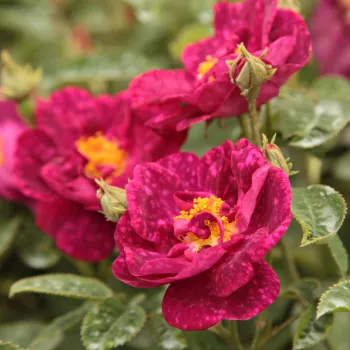
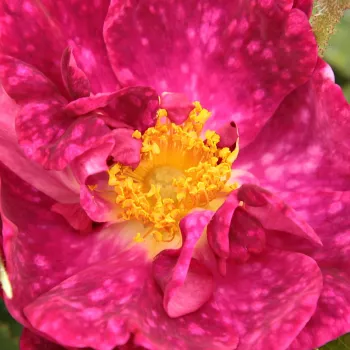
ALAIN BLANCHARD – crimson-red historical Gallica rose - Coquerel & Vibert
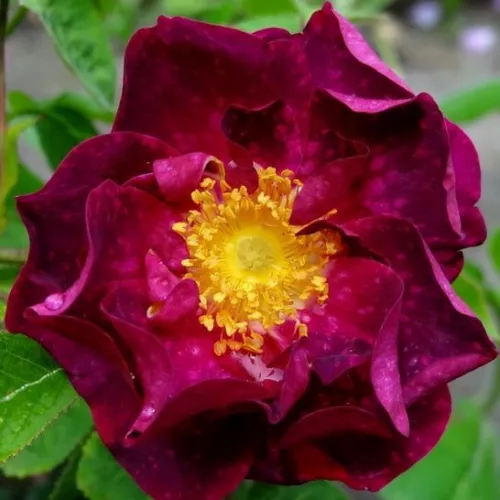
This classic Gallica shrub brings a sweep of history into your garden with its richly marbled crimson blooms and strong, spicy-fruity fragrance. Once-flowering in early summer, it covers itself in dusky purple-red flowers with pale speckles, creating a romantic focal point that needs remarkably little fuss. Its bushy, balanced habit and sparsely thorned stems make it easier to live with in a family garden, while the simple, open flowers are highly visited by bees and other pollinators. As an own-root shrub it matures steadily into a resilient long-term feature, regenerating from the base and keeping its ornamental value for many years. You can rely on it to cope with our damp Irish weather and frequent showers, especially if you give it decent drainage on heavier clay. First it builds roots, then stronger shoots, and by the third year it shows its full character as a generous, flowering hedge or specimen.
Use cases
| Target area | Reason |
|---|
| Front garden focal shrub |
Ideal if you want a single, eye-catching historic rose that makes an impact in early summer without demanding constant attention; its bushy, upright shape forms a natural feature in small or medium family front gardens, well suited to time-poor beginners |
| Scented cottage-garden border |
The strong, long-lasting spicy-fruity perfume and open, once-a-year flowering bring a traditional cottage atmosphere beside paths and windows; massed near seating areas, the fragrance and colour provide a seasonal highlight that rewards relaxed, low-input gardeners |
| Pollinator-friendly mixed bed |
The simple, open flowers with accessible stamens are highly attractive to bees and other pollinators, so a small group of shrubs will turn a mixed perennial bed into a buzzing, wildlife-friendly feature that remains easy to manage for nature-loving families |
| Seasonal rose hedge along boundaries |
Planted at the recommended hedge spacing, the bushy, moderately dense framework forms a soft, flowering boundary that needs only occasional shaping; the own-root shrubs build a stable, long-lived line of plants that suits patient, forward-planning homeowners |
| Partially shaded side garden |
This rose will still flower and hold its colour well with a few hours of sun, so it lends itself to Irish side passages and north-east aspects, where many modern roses struggle, offering dependable structure for space-conscious urbanites |
| Low-maintenance historic rose group (1–3 plants) |
A small cluster of plants quickly reads as a classic historic rose feature, yet needs only moderate upkeep; own-root growth adapts to local soil and care routine, making it a reassuring choice for those who want beauty without complex regimes, especially busy starters |
| Naturalistic bed with ornamental rose hips |
After flowering, the moderately produced orange-red hips add autumn interest among grasses and late perennials; this extends the season of a border and offers gentle wildlife value, appealing to those who enjoy subtle, changing scenes, particularly reflective gardeners |
| Country-style boundary in wet, windy areas |
Well suited to Irish gardens where frequent rain and wind are the norm, as this robust shrub handles changeable conditions when planted with reasonable drainage, giving a stable, long-term structure for coastal and rural owners |
Decorating ideas
- COTTAGE GATEWAY – Plant a pair flanking your front gate with catmint at their feet for a soft, tumbling edge and a wave of scent in early summer – for lovers of traditional cottage looks.
- HISTORIC MIX – Combine with delphiniums and tall foxgloves in a narrow border to frame a pathway, letting the rose anchor the display while perennials change through the season – for romantically minded homeowners.
- POLLINATOR STRIP – Create a short hedge of this rose backed by rudbeckias and ornamental grasses so bees enjoy the flowers, then birds and insects benefit from the hips – for wildlife-focused family gardens.
- QUIET CORNER – Position a single shrub near a bench, underplanted with lavender and hardy geraniums, so the strong fragrance and mellow colours define a calm reading nook – for busy people seeking a simple retreat.
- PARK-STYLE BORDER – Use a loose row of shrubs at the back of a sunny bed, with hydrangeas and hardy ferns stepping forward to cover the lower stems, echoing classic park plantings – for gardeners who like structured but relaxed designs.
Technical cultivar profile
| Property | Data |
|---|
| Name and registration |
Alain Blanchard is a historical Gallica hybrid shrub rose, commercial type historical Gallica rose; ARS exhibition name Alain Blanchard, unregistered cultivar, part of the Historic rose collection. |
| Origin and breeding |
Bred in France around 1829 by Coquerel and Jean-Pierre Vibert from Rosa centifolia × Rosa gallica; introduced circa 1839, with no formal registration year recorded in modern databases. |
| Awards and recognitions |
Recognised in American Rose Society shows as a Dowager Rose Queen in 1999 (Seattle Rose Society Show) and 2001 (Grosse Pointe Rose Society Show), highlighting its enduring exhibition appeal. |
| Growth and structure |
Bushy shrub reaching about 120–160 cm in height and 100–160 cm in spread, with moderately dense, matt olive-green foliage and sparsely thorned stems, forming a rounded, well-filled garden shrub. |
| Flower morphology |
Medium-sized, single to lightly petalled flowers with 5–12 petals, cup-shaped when opening and later flattening; mostly solitary on the stems and non-remontant, flowering once in a pronounced early-summer flush. |
| Colour and phenology |
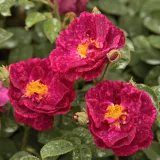
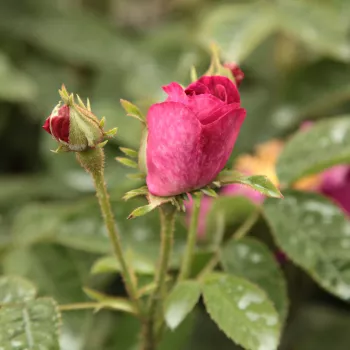
Rich crimson-red base with whitish-pink speckling; buds are dark crimson with silvery shimmer, ageing through vivid crimson to dusky mauve-purple with pale highlights, lightening and blurring in strong sun, fuller colour in cool conditions. |
| Fragrance and aroma |
Strong, long-lasting scent with spicy and fruity notes, easily noticeable in still air and effective for scented gardens or seating areas placed near the shrub during its main flowering period. |
| Rose hip characteristics |
Produces moderate numbers of spherical orange-red hips, about 16–24 mm in diameter; they can be quite ornamental in late summer and autumn, extending visual interest after the main flowering. |
| Resistance and hardiness |
Rated hardy to approximately −26 to −23 °C (RHS H7, USDA 5b, Swedish zone 4); disease resistance is moderate to powdery mildew, black spot and rust, requiring occasional protection in humid seasons. |
| Horticultural recommendations |
Best used in flowerbeds, hedges, specimen and park plantings, or scented gardens; plant around 110–120 cm apart for hedging, 200 cm as specimen, in well-drained soil with full sun or partial shade and medium maintenance. |
ALAIN BLANCHARD offers richly scented, pollinator-friendly historic flowers on a bushy, long-lived own-root shrub that settles in reliably over the years; consider it if You want a characterful yet undemanding rose.