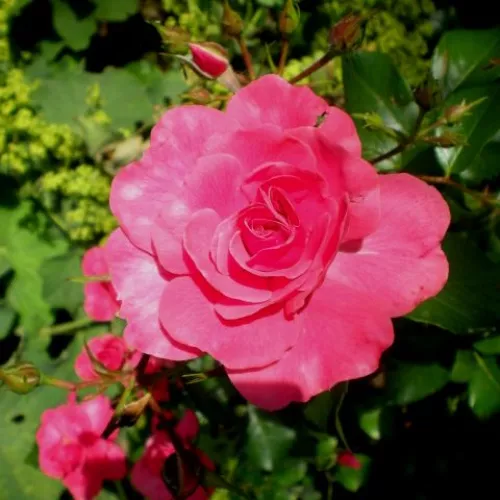
BAD BIRNBACH ® – pink bedding floribunda rose – Kordes
If You want a compact rose that simply works in an Irish family garden, BAD BIRNBACH ® is an easy, reassuring choice. Its bushy habit and dense, dark green foliage quickly knit into low, tidy hedges or edging, giving a natural yet orderly look without fussy shaping. The warm salmon-pink clusters repeat flower generously from early summer, keeping beds cheerfully colourful even when the weather turns unsettled and the soil stays heavy after rain. Semi-double blooms with visible stamens are gently welcoming to bees, while the overall care level remains comfortably manageable for beginners. As an own-root plant, the shrub stays stable and regenerates well, building a long-lived base for the front garden or cottage border. In a 40–50 litre container it remains compact and easy to tend, especially near doors, paths or patios. You can expect a gradual development arc – first year rooting in, second year stronger shoots, and by the third year a fully settled, reliable display.
Use cases
| Target area | Reason |
|---|
| Front garden edging along a path or driveway |
Low, bushy growth and dense foliage form a neat, continuous line that frames paths without blocking views, giving a tidy, welcoming first impression for busy homeowners who prefer easy structure over constant clipping, especially beginners |
| Small rose groups in mixed cottage-style beds |
Cluster-flowering, salmon-pink blooms repeat well through the season, so groups of three to five plants create soft colour waves that blend beautifully with perennials and give steady visual impact with minimum planning for hobby-gardeners |
| Family garden borders with limited maintenance time |
Medium maintenance and moderate disease resistance make it practical where You can manage simple annual pruning and occasional treatment but do not want demanding roses, offering a realistic balance between beauty and effort for busy-owners |
| Urban front gardens with heavier, wet-leaning soils |
Compact root system on its own roots establishes reliably in improved, well-drained clay-based beds, coping steadily with Ireland’s wetter spells and helping the planting stay consistent and attractive over many years for Irish-gardeners |
| Pollinator-friendly family spaces |
Semi-double flowers with accessible stamens offer some forage to bees and hoverflies, supporting a more alive, buzzing garden atmosphere without turning the whole border into a wildflower patch, a gentle step towards nature for wildlife-fans |
| Containers on patios, balconies or doorsteps |
Compact height and spread suit a 40–50 litre container, where the rounded form and repeat flowering create a colourful focal point that is easy to water, feed and enjoy up close for balcony-owners |
| Small informal hedges around play lawns or seating areas |
Regular, bushy habit and moderate thorniness allow low, informal hedges that visually separate spaces without harsh lines, helping define play or seating zones while still feeling soft and relaxed for family-gardens |
| Long-term, low-fuss rose plantings |
Own-root growth gives a durable, regenerating shrub that keeps its variety traits without graft worries, so after the first seasons of establishment it settles into a long life of dependable flowering with relatively light ongoing care for long-term-planners |
Decorating ideas
- Soft cottage ribbon – Plant a wavy line of BAD BIRNBACH ® along a lawn edge, weaving between clumps of oxeye daisy and nettle-leaved bellflower for a relaxed, meadowy front garden – ideal for lovers of traditional cottage style.
- Salmon-pink spotlight – Place three plants in a small triangle near your front door, underplanted with low lavender for fragrance and contrast, to create a cheerful, easy-care welcome – perfect for busy urban homeowners.
- Low rose hedge – Use a single row at 40 cm spacing to edge a family vegetable plot or play lawn, mixing in rosemary at corners for structure and scent – suited to families wanting gentle separation without tall fencing.
- Patio colour pot – Grow one plant in a 40–50 litre terracotta or half-barrel container with trailing thyme at the rim, keeping watering simple yet decorative – great for small patios and balcony gardeners.
- Park-style corner bed – Fill a sunny corner with a loose group of BAD BIRNBACH ® and tall verbena for airy height over a salmon-pink carpet effect – attractive to those who enjoy a polished, park-like look at home.
Technical cultivar profile
| Parameter | Data |
|---|
| Name and registration |
Floribunda bedding rose, collection Kordes' Klima-Rosen®. Registered as KORpancom, marketed as BAD BIRNBACH ® Kordes. ARS exhibition name: Bad Birnbach; group: bed rose. |
| Origin and breeding |
Bred by Reimer Kordes, W. Kordes’ Söhne, Germany, from ‘Weisse Immensee’ × ‘Bella Rosa’. Breeding year 1983, registered 1998 (ROS 1808), introduced 1999. |
| Awards and recognitions |
ADR Award 2000, ADR recommendation 2000, silver medal Madrid 1999 and Australian Certificate of Merit 2001, indicating strong garden and exhibition performance. |
| Growth and structure |
Compact, bushy shrub reaching about 40–60 cm in height and spread. Dense, glossy, dark green foliage gives good ground coverage; moderately thorny canes and naturally rounded habit suit edging and bedding. |
| Flower morphology |
Semi-double, flat, cluster-flowered blooms with 13–25 petals, medium-sized at roughly 4–7 cm. Remontant with an abundant second flush; flowers carried in trusses ideal for massed bedding effects. |
| Colour and phenology |
Warm salmon-pink flowers from vivid buds to pastel, cream-salmon tones as they open. Colour may lighten in strong sun and deepen slightly in cooler weather, giving a softly varied, season-long display. |
| Fragrance and aroma |
Fragrance is very weak and barely noticeable, so it is chosen primarily for colour and habit rather than scent. Best used where visual effect and ground coverage take priority over perfume. |
| Rose hip characteristics |
Produces moderate numbers of small, red, spherical hips about 6–10 mm across, adding discreet late-season interest and modest wildlife value if spent flowers are not all removed. |
| Resistance and hardiness |
Winter hardy to about −26 to −23 °C (USDA 5b, RHS H7, Swedish zone 4). Disease resistance is moderate to powdery mildew, black spot and rust; tolerates heat well with some information gaps on drought tolerance. |
| Horticultural recommendations |
Suitable for beds, edging, groundcover, small hedges, containers and urban green spaces. Plant at 40–45 cm in groups; prefers well-drained soil, regular feeding and occasional plant protection for best results. |
BAD BIRNBACH ® offers compact, bushy growth, generous repeat flowering and durable own-root performance that settles in for years of reliable colour, making it a reassuring choice if You want a long-lived rose You can simply enjoy.