DENTELLE DE BRUGES – white park rose – Lens
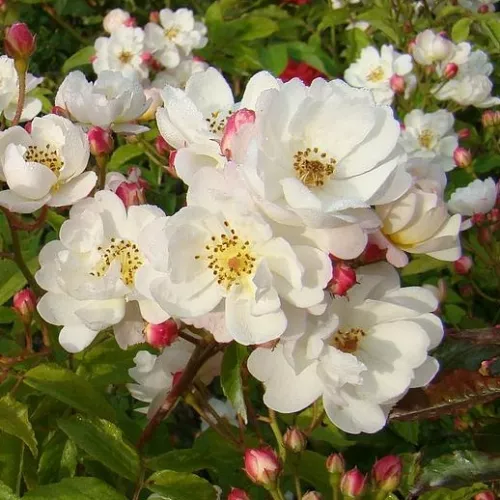
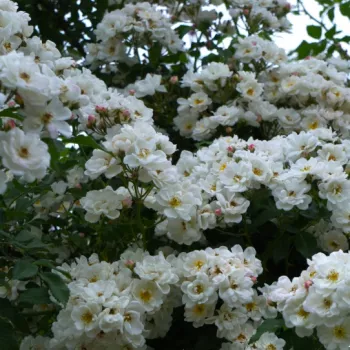
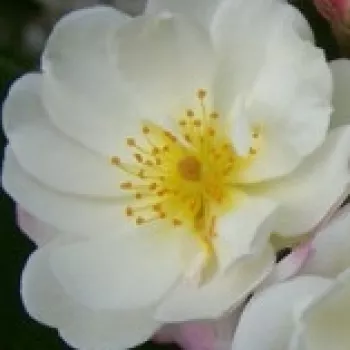
With its lacy clusters of snow-white blooms, Dentelle de Bruges is a romantic shrub rose that brings a light, airy charm to your garden with very little fuss. You get a tall, upright, bushy plant that flowers generously once in early summer, then carries small orange hips for the rest of the season, so there is always something to enjoy. The semi-double, open flowers are richly fragrant with a spicy-honey scent and their visible stamens make them welcoming to visiting bees. This own-root shrub settles in steadily in Irish gardens, coping well even where humidity and mild fungal pressure are part of everyday conditions. Over time it forms a long-lived framework of stems that can be lightly trained against a wall or fence for a soft, cottage look. Own-root plants are ideal if You want dependable structure with less replanting: roots in year one, stronger shoots in year two, then full, settled ornamental value from year three onwards. For best results, give it a reasonably drained spot, regular watering in dry spells and let this easy-care rose weave its lace-like screen around your home.
Use cases
| Target area |
Reason |
| Front garden focal point |
Dentelle de Bruges grows into a tall, upright shrub with airy clusters of white flowers, creating an immediate focal point near your entrance without complicated pruning or shaping, ideal if You want simple structure that still feels special for the busy beginner |
| Along walls and fences |
The flexible, bushy growth responds well to light tying-in, so You can soften bare walls or fences with a curtain of white blooms and orange hips while keeping maintenance to a minimum and avoiding the work of a true climber, perfect for the low-maintenance homeowner |
| Pollinator-friendly cottage borders |
Semi-double flowers with exposed golden stamens and a strong spicy-honey scent are attractive to bees, so a small group of plants will lend romantic cottage character and useful nectar in early summer, suiting the nature-loving gardener |
| Partially shaded side gardens |
This shrub tolerates partial shade, so it performs reliably where many roses struggle, such as east-facing or lightly shaded side gardens, helping You turn awkward, less-sunny spots into fresh white summer displays suited to the urban plot-owner |
| Low-intervention family planting |
With medium disease resistance and simple shrub shaping, this rose fits busy households that manage only occasional spraying and basic pruning, yet still expect it to last for many seasons, offering reassurance for the time-pressed family |
| Long-term framework in mixed beds |
As an own-root shrub it gradually forms its mature shape in place, giving a stable, regenerating framework for perennials and smaller roses around it without frequent replacement, which suits the long-range planner |
| Seasonal interest with hips |
After flowering, the shrub carries clusters of small orange hips that extend interest into autumn, pairing well with late-flowering perennials and offering gentle colour even when petals have gone, an appealing choice for the all-season observer |
| Small rose groups in exposed Irish gardens |
Planted in groups of 1–5, these sturdy shrubs give reliable early-summer impact and settle well even in typical Irish gardens where damp air and fungal pressure are common, providing confidence for the cautious beginner |
Decorating ideas
- White cottage hedge – Plant a loose row along a front boundary and underplant with low Lonicera nitida ‘Maigrün’ to frame your home in soft white and green – ideal for lovers of relaxed cottage style.
- Romantic entrance arch – Train a couple of shrubs gently onto an arch or tall support, filling the top with fragrant white clusters and pairing with lavender at the base – perfect for fragrance-focused homeowners.
- Bee-friendly drift – Use three shrubs in a curved bed with Echinops and other blue perennials to create contrasty, nectar-rich planting – great for wildlife gardeners and families with curious children.
- Wall-washed patio corner – Set a shrub against a sunny wall near your seating area, teaming it with pots of rosemary and hydrangea for texture and scent – suited to compact urban patios.
- Seasonal feature border – Combine Dentelle de Bruges with Liatris spicata ‘Alba’ and airy grasses for a light, see-through summer display that fades into hips and seedheads – ideal for design-conscious beginners.
Technical cultivar profile
| Property |
Data |
| Name and registration |
Dentelle de Bruges (registered as LENmule) is a shrub Hybrid Musk rose from the Park - shrub rose group, sold here as a premium, own-root pharmaROSA ORIGINAL 2-litre garden rose. |
| Origin and breeding |
Bred by Louis Lens in Belgium from ‘Seagull’ × ‘Mühle Hermsdorf’, introduced and registered in 1990, with breeding completed in 1988 by Lens Roses; commercial distribution began through Lens Roses. |
| Growth and structure |
Strong, upright, bushy shrub reaching about 170–230 cm in height and 120–180 cm spread, with moderately dense, mid-green, slightly glossy foliage and moderate prickliness, forming a substantial landscape presence. |
| Flower morphology |
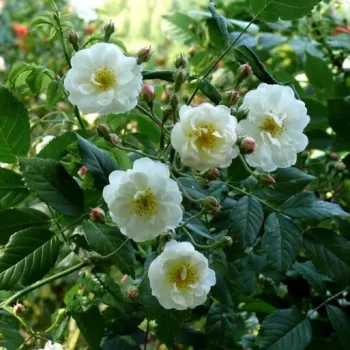
Semi-double, cup-shaped flowers with 13–25 petals borne in large, many-flowered clusters; small blooms of roughly 0.5–1.5 inches across, flowering freely in one long early-summer flush rather than repeating later. |
| Colour and phenology |
Buds open from deep crimson-red to pale cream, quickly becoming pure snow-white with a translucent effect; petals may show a faint greenish tinge before fading, with bright golden-yellow stamens at full bloom. |
| Fragrance and aroma |
Strong, complex scent combining spicy and honeyed notes, evident around the plant in still weather; semi-double, open blooms make the fragrance and pollen readily accessible to garden visitors and pollinating insects alike. |
| Rose hip characteristics |
Produces moderately abundant, small spherical orange hips about 6–10 mm across, grouped in clusters where flowers have been, adding subtle autumn and early winter interest, especially in mixed borders or near paths. |
| Resistance and hardiness |
Medium resistance to black spot, powdery mildew and rust; suited to average Irish garden care. Hardy to about −18 to −15 °C (RHS H6, Swedish zone 2, USDA 7a), coping with normal winter conditions when well established. |
| Horticultural recommendations |
Use as a specimen, informal hedge or along walls and fences; suitable as a pollinator-friendly shrub and occasional cut flower source. Allow space of 130–220 cm per plant depending on role, with 0.5–0.6 plants per m² for massing. |
Dentelle de Bruges offers tall, romantic white flowering, pollinator-friendly blooms and long-lived own-root reliability for easy, lasting structure in Irish family gardens, making it a thoughtful choice if You prefer roses that quietly get on with the job.