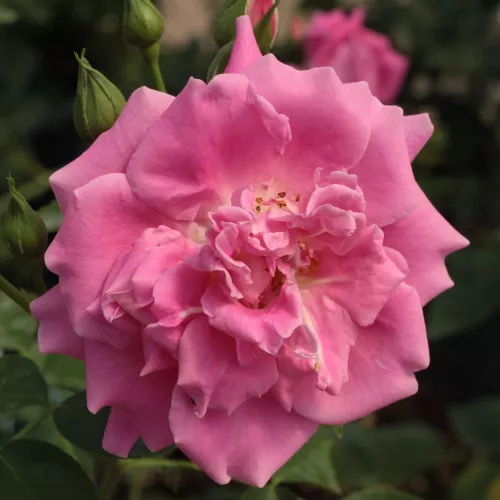
ROUNDELAY – dark‑red bedding grandiflora rose - Swim
If You love classic roses but want something genuinely reliable and easy to live with, ROUNDELAY is a dark, velvety grandiflora that fits naturally into everyday Irish gardens. Its rich, long-lasting blooms bring a quietly romantic feel to small front gardens, low hedges and mixed borders, while the upright, bushy habit keeps the plant tidy without constant work. Grown as a pharmaROSA® ORIGINAL own-root rose, it settles in steadily for a long garden life with strong regrowth from the base, instead of short-lived, grafted top growth. Once planted in reasonably drained soil that copes with our wetter spells and humidity, the plant forms a stable structure that responds well to ordinary, family-garden care. With regular deadheading and simple feeding, You can expect a pleasing development arc – good root building in year one, more leafy cover and flowers in year two, and full ornamental impact from about year three. Compact enough for smaller beds yet generous in flower, it works beautifully as a repeat-flowering centrepiece or in small groups, giving You dependable colour without complicated maintenance.
Use cases
| Target area |
Reason |
| Small front garden bed by the entrance |
Compact, upright growth and medium height allow Roundelay to fit neatly into narrow front beds while still making a strong visual statement from the pavement, ideal if You want a reliable focal point that stays tidy for busy beginners |
| Formal or semi-formal flowerbed in a family garden |
The flowerbed grandiflora character and repeat, abundant second flush provide a long season of deep red colour that suits simple, structured planting schemes without demanding complex pruning, supporting those who like a classic look with minimal effort |
| Small group planting of 3–5 roses |
Planted in small groups at the recommended spacing, Roundelay forms a coherent, bushy block of colour with moderately dense foliage, giving a filled-in look within a few seasons and reducing the need for intricate underplanting for time-pressed homeowners |
| Specimen rose in a mixed cottage-style border |
The velvety, dark-red blooms and high-centred, cut-rose form stand out against looser perennials and cottage favourites, providing a single, eye-catching specimen that anchors the border without needing elaborate training for relaxed gardeners |
| Cutting patch or dedicated cut-flower corner |
High-centred, pointed buds and medium-sized, double flowers on upright stems lend themselves to cutting, so a few plants can supply repeat bunches for the house across the season, adding value for those who like fresh flowers but have limited time |
| Low rose hedge along a drive or path |
With its upright bushy habit, recommended hedge spacing and self-cleaning tendency, Roundelay can form a low, clearly defined boundary that looks cared-for with only occasional pruning and deadheading, suiting families who prefer straightforward maintenance |
| Large container on a sunny patio or balcony |
When planted alone in a 40–50 litre container of quality compost and kept evenly watered, Roundelay’s moderate size and repeat flowering make a strong feature that copes well with coastal moisture and persistent humidity for urban and coastal balcony owners |
| Long-term bed or park-style planting |
As an own-root rose with good hardiness down to about -21 °C, Roundelay gradually forms a durable, well-balanced shrub that can be rejuvenated from the base if cut back, making it a sound, long-term choice for low-input, established gardens |
Decorating ideas
- Cottage Border Duo – Combine Roundelay with lavender and airy perennials to soften its rich red blooms in a relaxed border – ideal for lovers of traditional cottage gardens.
- Front-Garden Accent – Plant a trio of Roundelay near the gate with low evergreen edging for a simple yet impressive welcome – perfect for busy households wanting instant kerb appeal.
- Patio Feature Pot – Use a single Roundelay in a 40–50 litre terracotta container with trailing thyme around the base – suited to small urban patios where space is limited.
- Red-and-Green Contrast – Pair Roundelay with glossy evergreens such as cherry laurel and grey lavender cotton to highlight the velvety flowers – great for those who like bold colour contrasts.
- Cutting Corner Mix – Place Roundelay in a small cutting bed with crocosmia and salvias for easy, repeat bouquets – appealing to gardeners who enjoy bringing home-grown flowers indoors.
Technical cultivar profile
| Parameter |
Data |
| Name and registration |
Roundelay is a grandiflora bed rose marketed as a bedding rose type; ARS exhibition name Roundelay, commercial description dark-red bedding grandiflora rose, unregistered but authenticity verified for this product. |
| Origin and breeding |
Bred by Herbert C. Swim at Armstrong Nurseries, California from ‘Charlotte Armstrong’ × ‘Floradora’; introduced in 1953 in the United States and distributed originally by Armstrong Nurseries. |
| Awards and recognitions |
Recognised internationally with a Gold Medal and City of Geneva Prize in 1954 trials in Geneva, and later awarded an RNRS Trial Ground Certificate in 1958 for its overall garden merit. |
| Growth and structure |
Upright, bushy shrub reaching about 85–115 cm high and 75–105 cm wide, with moderately dense, glossy dark green foliage and moderate prickliness; maintains a well-defined, tidy outline in beds and small groups. |
| Flower morphology |
Medium-sized, double blooms with 26–39 petals, high-centred and pointed buds in a classic cut-rose style; flowers are usually borne in clusters and repeat well, with an especially abundant second flush in season. |
| Colour and phenology |
Deep, velvety dark red with a subtle burgundy hue; buds open from deep burgundy to crimson, retaining colour with very good resistance to fading, only slightly paler in strong sun and deeper toned in cooler weather. |
| Fragrance and aroma |
Fragrance strength is strong and long-lasting, with a classic scented-rose character; while detailed scent notes are not available, the intensity makes it suitable for seating areas and cutting for indoor enjoyment. |
| Rose hip characteristics |
Rose hips are few due to the double blooms but, when present, are 12–18 mm, ellipsoid and red (RHS 44A), contributing modestly to late-season interest rather than being a primary ornamental feature. |
| Resistance and hardiness |
Hardy to about -21 to -18 °C (H7, USDA 6b, Swedish zone 3); disease resistance is medium overall but it is very susceptible to black spot, requiring occasional fungicidal protection in humid, high-pressure seasons. |
| Horticultural recommendations |
Best in full sun with well-drained soil and regular watering during drought; spacing 65 cm in mass plantings, 55 cm for hedges or 100 cm as a specimen; suitable for beds, parks, cut flowers and small landscape groupings. |
ROUNDELAY offers rich repeat flowering, a compact, tidy habit and own-root longevity that suits straightforward, long-term plantings, so You can enjoy dependable colour with manageable care whenever You decide to plant it.