FÉLICITÉ ET PERPÉTUE – white historic rambler rose (climbing/trailing) - Jacques
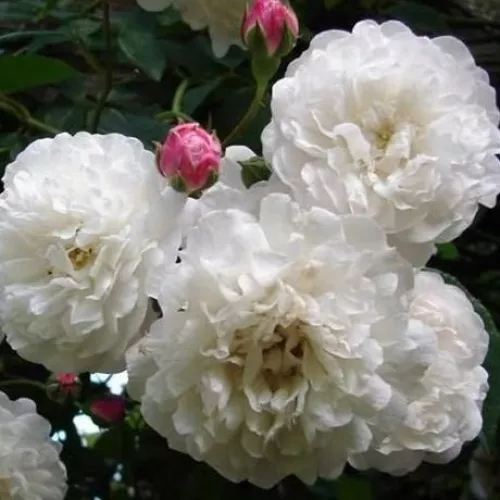
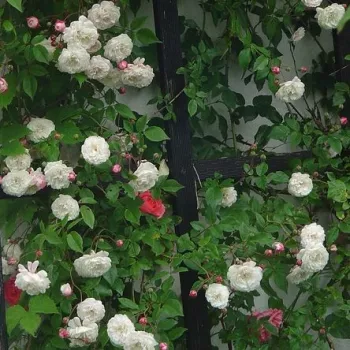
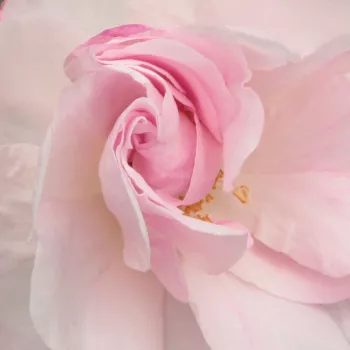
If You dream of a romantic, cottage-style rambler that You simply plant and let it get on with the job, Félicité et Perpétue is a quietly reliable choice. This historic hybrid sempervirens rambler brings easy-care charm to Irish gardens, coping well even where heavy soil needs some drainage in wetter weather. Once settled, it builds long, graceful, mid-green shoots with glossy foliage and only sparse prickles, ideal for training onto arches, pergolas, old trees or along a boundary. In early summer it covers itself in clusters of small, very double, creamy-white pompon blooms born from soft pink buds, creating a cloud-like effect along the entire length of the stems. Disease resistance is reassuringly strong, so You can enjoy its display with minimal spraying and less time spent on plant doctoring. As an own-root plant, it ages into a solid, long-lived framework that can regenerate from the base, giving a dependable lifetime feature for the family garden. In year one it focuses on roots, in year two the framework builds, and by year three You see the full ornamental impact that makes this heritage rambler feel truly established.
Use cases
| Target area |
Reason |
| Front-garden trellis or house wall |
Excellent climbing growth habit with long, flexible canes that are easy to fan out along wires or trellis, creating a soft, romantic façade without taking much ground space, especially helpful for the busy urban home gardener seeking simplicity |
| Pergola or arch over a path |
High, vigorous growth (up to 5–8 m) allows it to quickly cover arches and pergolas, forming an early-summer tunnel of creamy-white, very double flowers that frames garden paths beautifully for design-conscious |
| Low-maintenance cottage-style boundary |
Dense, glossy mid-green foliage and moderate self-cleaning keep the plant attractive with relatively little attention, lending itself to relaxed cottage-style boundaries where You prefer pruning over regular spraying for time-poor |
| Training into mature trees |
Historical rambler vigour and scrambling habit make it ideal for allowing shoots to weave through small trees, where once-a-year flowering creates a magical white veil in early summer for romantics |
| Country or coastal family garden feature |
Good heat and moderate drought tolerance, plus reliable performance where wetter climates meet heavier soils, suits Irish country and coastal plots that need tough, unfussy climbers for practical |
| Wall-trained rose in partial shade |
Suitability for partial shade means it will still flower well on east- or north-east-facing walls, extending rose planting options in smaller gardens with limited full sun for space-conscious |
| Low-chemical, long-lived rose planting |
Strong resistance to powdery mildew, black spot and rust reduces the need for chemical treatments, while own-root growth gives a durable, regenerating framework for decades of use, appealing to eco-minded |
| Historic and collector-style garden corners |
A genuine historic rambler with RHS Award of Garden Merit status brings authenticity and proven garden reliability, forming a characterful focal point that matures gracefully over many years for collectors |
Decorating ideas
- COTTAGE PORCH VEIL – Train Félicité et Perpétue around a small porch or doorway, underplanting with soft pink lupins and dwarf heuchera for layered texture – suited to homeowners wanting a storybook cottage feel.
- ROMANTIC PERGOLA WALK – Let its long canes cloak a garden pergola, combining with lavender or rosemary at the base to scent the path below – ideal for families who enjoy relaxed summer evenings outdoors.
- TREE-DRAPED WHIMSY – Allow it to climb into a light-canopy ornamental tree, pairing with switchgrass ‘Sangria’ beneath for airy movement – perfect for gardeners seeking a naturalistic, slightly wild corner.
- HERITAGE COURTYARD WALL – Fan the rambler over an inner courtyard wall and mix nearby pots of hydrangea for contrast – good for urban gardeners wanting a refined historic touch in compact spaces.
- LOW-MAINTENANCE BOUNDARY SCREEN – Use along a fence or wire to form a softly romantic screen, with simple groundcover perennials in front to keep weeding light – best for busy households prioritising impact over upkeep.
Technical cultivar profile
| Parameter |
Data |
| Name and registration |
Trade name Félicité et Perpétue, historic rambler from the Jacques collection; American Rose Society exhibition name Félicité-Perpétue; unregistered cultivar, commonly listed among historical roses. |
| Origin and breeding |
Bred by Antoine Jacques in France from Rosa sempervirens crossed with a Noisette rose; raised in the Château de Neuilly gardens and introduced around 1827 as a vigorous, once-flowering rambler. |
| Awards and recognitions |
Holds the Royal Horticultural Society Award of Garden Merit (1993), confirming reliable garden performance, and has received Dowager Queen honours from the American Rose Society for outstanding historic rose quality. |
| Growth and structure |
Strong climbing rambler with 5–8 m height and 3–5 m spread; flexible, trainable canes, dense mid-green glossy foliage and relatively sparse prickles, suitable for trellis, walls, pergolas, arches or tree training. |
| Flower morphology |
Small, very double, globular pompon flowers with over 40 petals; borne in generous, clustered trusses along the canes; not remontant, providing one abundant early-summer flowering period each year. |
| Colour and phenology |
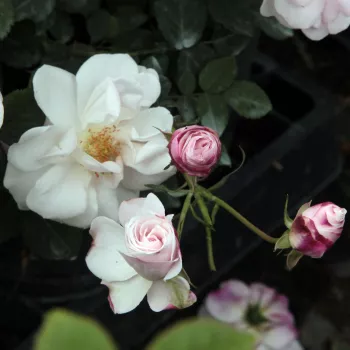
Flowers open from pale pink-cream buds to creamy white with faint pinkish sheen, maturing to a clean off-white; colour holds well in sun with little fading, giving a uniform soft-white display at full bloom. |
| Fragrance and aroma |
Fragrance is very weak and barely noticeable, with a light classic rose character; primarily grown for its massed visual effect and historic charm rather than for strong scent in the garden. |
| Rose hip characteristics |
Occasionally sets small spherical orange-red hips around 8–12 mm in diameter, which may add a modest ornamental touch later in the season when present on the plant. |
| Resistance and hardiness |
Good overall disease resistance, with noted resistance to powdery mildew, black spot and rust; hardy to about -21 to -18 °C (RHS H7, USDA 6b), also tolerates heat and moderate drought in average garden soils. |
| Horticultural recommendations |
Suited to walls, pergolas, arbours, tree-training and specimen use; prefers support and basic pruning after flowering; plant at recommended spacings, and use a minimum 40–50 litre container if grown in a large patio pot. |
Félicité et Perpétue offers easy-care vigour, reliable once-a-year early-summer coverage and strong disease resistance, and as an own-root rambler it matures into a long-lived, regenerating feature, so You can choose it with confidence for your garden.