SUPER EXCELSA – crimson-red climbing rambler rose - Hetzel
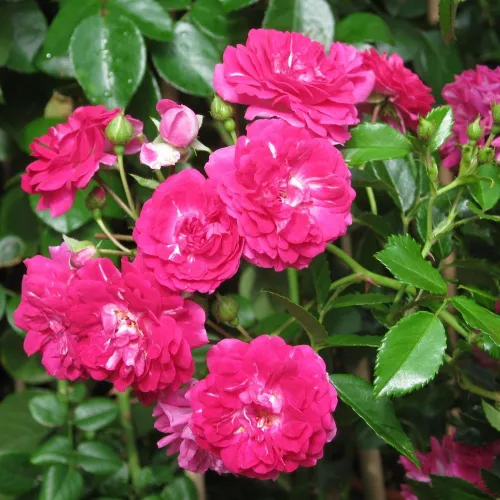
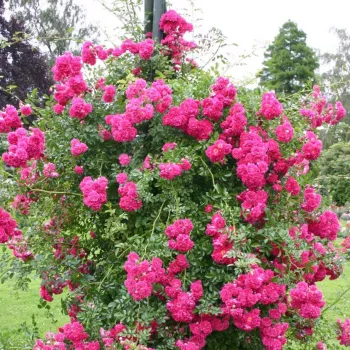
If You dream of a romantic cottage-style arch or fence smothered in crimson-red clusters with minimal fuss, Super Excelsa is made for You. This reliable climbing rambler covers walls, pergolas and obelisks in a single, spectacular early-summer flush, then quietly looks after itself with only light seasonal work. On its own roots it settles in steadily for a long life, forming a stable, well-shaped climber that copes well with humid Irish conditions where fungal problems and heavier soil are common. In year one it concentrates on roots, in year two the main shoots fill out, and by year three You enjoy its full ornamental value as a dense vertical curtain of colour. The semi-double clusters offer a naturally soft look and a touch of movement in the breeze, while the very light fragrance makes it perfect for seating areas where You prefer colour over scent. Once flowering has finished, occasional orange-red hips appear, adding a gentle autumn accent and extra interest for wildlife.
Use cases
| Target area |
Reason |
| Front-garden arch or pergola |
Ideal where You want one big, reliable early-summer show without constant pruning. The once-flowering clusters smother an archway for a few dramatic weeks, then the neat foliage frames your entrance for the rest of the year, suiting time-poor beginners |
| Sunny wall in a family garden |
Climbs 2–3 m with dense, glossy foliage, giving You a long-lived vertical “flower curtain” that screens views and adds character. Own-root plants develop a balanced structure that rebounds well after wind, perfect for exposed Irish sites and homeowners |
| Rustic fence or boundary |
The vigorous rambler habit easily clothes a rural fence, fitting classic cottage styles. Medium maintenance means simple yearly tying-in and a light tidy after flowering, so You gain a romantic boundary feature without high upkeep, ideal for busy families |
| Small group of 2–3 plants on a pergola |
Plant in a triangle around posts to create a tunnel of crimson-red clusters. Over 2–3 seasons they knit together into a continuous screen, offering strong visual impact from a modest number of plants, a smart choice for budget-conscious gardeners |
| Partially shaded side passage or gable |
Tolerates partial shade, so it still flowers well where sun is limited to part of the day. The dark green leaves stay attractive after the main flush, bringing structure and colour to awkward side areas, suiting urban plots and narrow spaces for neighbours |
| Coastal or wind-exposed trellis |
Hardy to around -30 °C with a resilient climber framework, it copes with blustery, damp Irish conditions and soils that drain slowly after heavy rain, so You gain a long-term vertical feature where other roses might struggle, reassuring less-confident planters |
| Wildlife-friendly corner with shrubs |
Semi-double flowers offer accessible pollen in season, while occasional orange-red hips extend interest into autumn. Combined with flowering shrubs, it supports garden biodiversity without complex management, appealing to nature-loving cottage-style owners |
| Large container against a house wall |
Can be grown in a 40–50 litre container with good drainage and regular watering, letting You enjoy a flowering climber even on paved or rented spaces. The once-annual pruning and tying keep tasks simple for balcony and patio-focused residents |
Decorating ideas
- Cottage Archway – Train Super Excelsa over a simple metal arch and underplant with lavender and catmint for a soft, old-fashioned entrance – for romantic, low-maintenance front-garden lovers
- Colour-Wash Fence – Let several plants scramble along a timber fence, teamed with hardy geraniums and ornamental grasses to blur boundaries – for families wanting easy privacy with seasonal drama
- Porch Welcoming Frame – Guide canes up each side of a porch and across a beam, backed by white hydrangeas for contrast – for homeowners who like a tidy, welcoming doorway with one big summer show
- Wildlife Nook – Combine this climber with dogwood and salvia in a corner bed so blooms, hips and stems give birds and insects interest through several seasons – for nature-focused gardeners seeking simple structure
- Patio Feature Pot – Plant a single rose in a 40–50 litre container with trailing thyme and ivy at the base, tying stems to a slim obelisk – for renters and balcony users who want vertical colour without permanent works
Technical cultivar profile
| Property |
Data |
| Name and registration |
Registered as HELexa, marketed as Super Excelsa climbing rambler rose. Part of the Climbing rose collection, in the rambler and large-flowered climber group, with ARS exhibition name Super Excelsa. |
| Origin and breeding |
Hybrid of Excelsa crossed with an unknown pollen parent, bred by Karl Hetzel in Germany and introduced in 1986. Developed as an improved, higher-performing form of Excelsa with enhanced garden usefulness. |
| Awards and recognitions |
Holds the Royal Horticultural Society Award of Garden Merit, indicating dependable performance, good ornamental value and stable behaviour under typical garden conditions when grown with reasonable care. |
| Growth and structure |
Strong climbing rambler reaching about 220–340 cm high and 190–310 cm wide. Produces dense, dark green, glossy foliage on moderately thorny canes, forming a full vertical screen when trained and tied in. |
| Flower morphology |
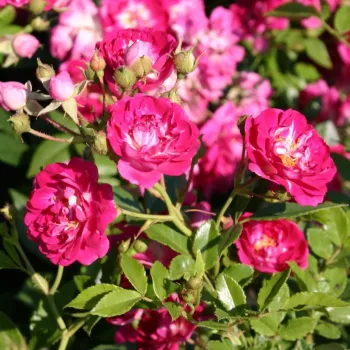
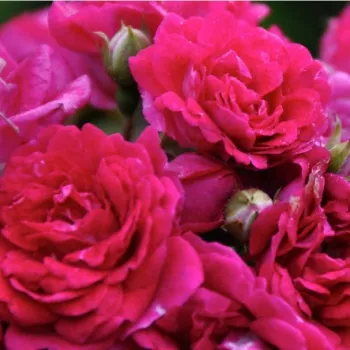
Semi-double, cup-shaped blooms with approximately 13–25 petals. Small-flowered clusters (around 0.5–1.5 inches) are produced in large trusses. Non-remontant, giving one main, very abundant flowering period each year. |
| Colour and phenology |
Crimson-red outer petals with a narrow whitish centre at the throat, sometimes leaning to purplish tones when fully open. Colour may lighten in strong sun, creating magenta-red to reddish shades through the bloom phase. |
| Fragrance and aroma |
Very weak scent, perceived as a delicate, soft aroma rather than a strong perfume. Best chosen where colour impact and coverage are more important than fragrance, such as arches, fences and boundary plantings. |
| Rose hip characteristics |
Occasionally forms small, spherical orange-red hips measuring roughly 6–10 mm. These add subtle autumn and early winter interest and can provide an additional food source for birds in wildlife-conscious gardens. |
| Resistance and hardiness |
Hardy to approximately -32 to -29 °C (USDA zone 4b, Swedish zone 5). Disease resistance is medium for black spot, powdery mildew and rust; benefits from good air circulation and standard preventive care. |
| Horticultural recommendations |
Best on walls, fences, arches, pergolas or obelisks with sturdy support. Space roughly 230–240 cm for hedges or mass planting, 400 cm as a specimen. Suitable for partial shade; keep soil moist but free-draining and prune after flowering. |
Super Excelsa offers a spectacular early-summer display, long-lived climbing coverage and medium-care reliability on its own roots, making it a reassuring choice if You want colour and structure without complex rose work.