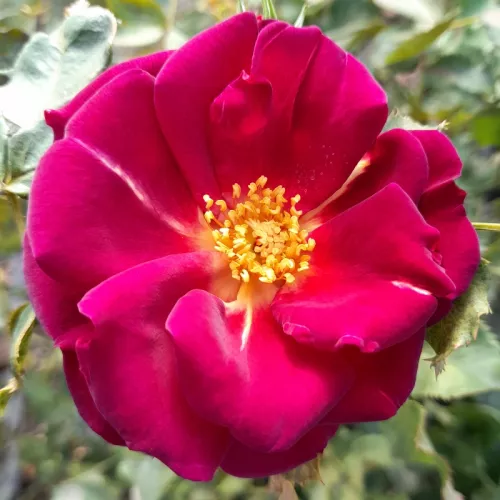
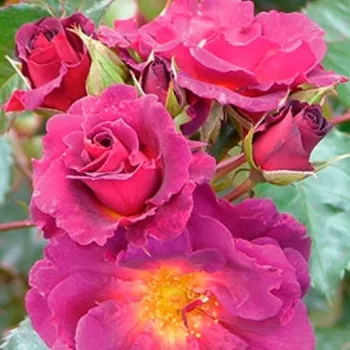
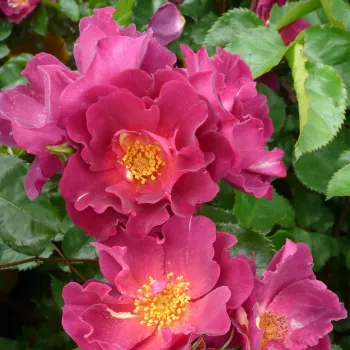
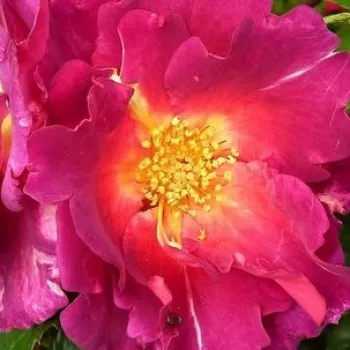
Wild Rover – deep purple park rose – Dickson
If You love richly coloured roses but prefer easy gardening, Wild Rover is made for You: a deep purple, upright shrub that settles quickly into Irish family gardens and copes well with our humid seasons and heavy soil when drainage is considered. Its medium-sized, semi-double clusters flower repeatedly from early summer, giving generous waves of colour with a bright golden eye that stands out even from the pavement. The strong, long-lasting fragrance has a sweet, spicy note that brings classic rose character right up to Your front door or patio seating area. As an own-root shrub it builds a stable, long-lived structure, so if You plant it once and keep it watered and fed, it will reward You for years with reliable performance. In the first year it focuses on roots, in the second on building shoots, and by the third season it reaches its full ornamental value as a striking, easy-going park rose for everyday gardens.
Use cases
| Target area |
Reason |
| Front garden focal point near the entrance |
Upright, dense growth and deep purple blooms create an instant focal point beside paths or gates, giving strong colour from street view without fussy pruning or complicated care, ideal for the busy homeowner |
| Small group of 3 shrubs in a mixed border |
Planted in a loose triangle at 1 m spacing, three plants form a balanced, medium-tall group that flowers in repeated flushes, filling gaps among perennials while staying manageable in an average family border for the hobby gardener |
| Cottage-style bed with perennials |
Its slightly informal, cluster-flowered habit and mauve-purple tones pair beautifully with cranesbill, catmint or foxgloves, giving a relaxed, near-natural cottage feel that still looks tidy enough around the home for the rural gardener |
| Long-lived backbone rose in a family garden |
As an own-root shrub it thickens from the base over time and can regenerate from its own wood if cut back or weather-damaged, offering a durable, decades-long feature that matures with the garden for the long-term planner |
| Urban front garden with limited space |
The upright, 120–180 cm habit gives plenty of vertical interest from a relatively small footprint, so You get height, colour and scent in a narrow bed without the sprawling bulk of larger shrubs for the townhouse owner |
| Patio container or small paved garden |
Thrives in a generous 40–50 litre container with good compost and regular watering, giving repeat colour and fragrance where there is no soil, such as paved front yards or terraces, suiting the balcony gardener |
| Flowering hedge or loose screen |
Planted at about 90 cm intervals, the moderately thorny, leafy stems knit into a semi-formal hedge that offers privacy, scent and colour while remaining easier to manage than very vigorous shrub roses for the practical planner |
| Beds in wetter, Atlantic-influenced gardens |
Performs reliably in Ireland’s cool, damp conditions when given reasonable soil preparation and drainage, coping with our changeable seasons and helping maintain a balanced, low-fuss planting for the Irish gardener |
Decorating ideas
- Doorstep Welcome – Plant a single Wild Rover by the front path with lavender edging to frame the entrance in scent and purple hues – ideal for homeowners wanting a smart welcome with little maintenance
- Cottage Curve – Curve a trio of shrubs through a cottage bed with cranesbill ‘Rozanne’ and foxgloves for relaxed layers of purple and pink – perfect for fans of traditional rural Irish garden style
- City Balcony Accent – Grow one plant in a 40–50 litre pot with trailing thyme and heuchera to create a vertical accent on a small patio – suited to urban gardeners with limited ground space
- Family Retreat – Use a loose row as a scented backdrop behind a lawn bench, underplanting with hardy geraniums for a soft, child-friendly corner – great for families seeking an easy, calming sitting area
- Evening Colour Strip – Combine Wild Rover with white hydrangeas and silver foliage plants along a terrace for dusk-friendly contrast and fragrance – ideal for people who enjoy their garden mainly after work
Technical cultivar profile
| Parameter |
Data |
| Name and registration |
Wild Rover – deep purple park rose (registered as DIChirap), shrub rose group, exhibition floribunda / shrub category; ARS exhibition name Harry Potter, verified cultivar authenticity for garden use. |
| Origin and breeding |
Bred by Colin Dickson, Dickson Nurseries Ltd, New Ireland, Great Britain; cross of ‘Spice of Life’ × ‘Rhapsody in Blue’; introduced and registered in 2007, initially distributed by C & K Jones in the United Kingdom. |
| Awards and recognitions |
Highly regarded internationally: Silver Medal at Viña del Mar International Rose Competition (2004), Certificate of Merit at the Glasgow Rose Trials (2010), and RHS Award of Garden Merit (2012) confirming reliable garden performance. |
| Growth and structure |
Vigorous, upright shrub to about 120–180 cm high and 75–125 cm wide, with dense, slightly glossy light-green foliage and moderate prickliness; forms a full, leafy framework suitable for specimens, groups or low hedging. |
| Flower morphology |
Semi-double, flat, medium-sized flowers (about 4–7 cm) carried in clusters; 13–25 petals per bloom, moderate self-cleaning so some deadheading is beneficial to keep the shrub neat and encourage repeated flowering flushes. |
| Colour and phenology |
Deep crimson-purple base tone with subtle mauve; buds are almost blackish burgundy, opening to glossy dark outer petals and lighter edges, then fading towards mauve-lilac; golden-yellow stamens give a vivid central contrast in full bloom. |
| Fragrance and aroma |
Strong, sweet and spicy scent with good persistence around the plant, noticeable on still evenings and along paths; flowers in repeated flushes during the season, so perfume is present for much of the summer in suitable garden conditions. |
| Rose hip characteristics |
Occasional small spherical hips, about 8–13 mm, red (RHS 40A); generally a minor visual feature, appearing after good pollination if spent blooms are left, but usually not dominant in the overall garden appearance. |
| Resistance and hardiness |
Winter hardy to about −21 to −18 °C (RHS H7, USDA 6b, Swedish zone 3); moderate resistance to black spot, mildew and rust, benefits from airy planting; flowers well in heat with watering during extended dry spells. |
| Horticultural recommendations |
Best in fertile, well-drained soil with sun or light partial shade; spacing 100 cm for groups, 90 cm for hedges, 180 cm as a specimen; suitable for beds, parks, urban plantings and cutting, plus large containers of at least 40–50 litres. |
Wild Rover offers rich purple colour, strong fragrance and a long-lived own-root shrub habit that settles reliably into Irish gardens; consider it if You want a striking yet straightforward rose to enjoy for many seasons.