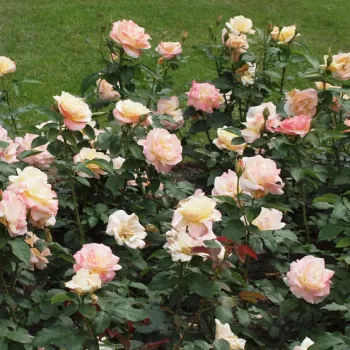
APRICOT QUEEN ELIZABETH – apricot-pink bedding grandiflora rose - Verschuren
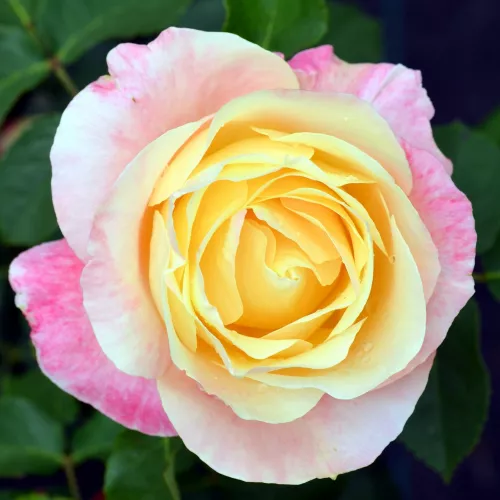
If You love elegant roses but prefer straightforward gardening, APRICOT QUEEN ELIZABETH is an easy-going grandiflora that fits beautifully into Irish family gardens. Its upright, bushy habit creates a naturally neat shrub that looks well-kept without constant shaping, while clusters of large, double blooms in soft peach-pink shades give a reliably romantic effect from early summer into autumn. As an own-root plant, it develops a strong framework over time for a genuinely long-lived, stable presence in the border. With simple care and reasonable drainage it copes well even where soil stays heavy after rain, making it a reassuring choice in typical Irish conditions. The flowers carry a surprisingly strong, long-lasting fragrance, so You can cut stems for the house without losing the show outdoors. Planted in a 40–50 litre container or a front bed, it creates reliable impact within a couple of seasons, then continues to mature steadily, moving from root-building in year one to fuller branching in year two and its best ornamental display by year three.
Use cases
| Target area |
Reason |
| Front garden feature shrub by the entrance path |
The upright, bushy growth and dense, glossy foliage form a tidy vertical accent that reads as “well looked after” with only light pruning, ideal for welcoming visitors in small Irish front gardens where You want order without fuss for the busy homeowner audience |
| Small rose group of 3–5 in an ornamental bed |
Cluster-flowering, large double blooms repeat through the season, so a small group quickly looks generous and colourful, giving that classic rose-bed feel without needing a big planting area for the beginner gardener audience |
| Mixed border in typical heavy Irish garden soil |
As an own-root shrub with moderate height and spread, it knits steadily into mixed plantings beside perennials and small shrubs, coping well where clay holds moisture after rain and offering long-term structure for the practical planner audience |
| Cutting corner for scented indoor arrangements |
Long, straight stems and strong, sweet fragrance make it excellent for vases; repeat flowering ensures the border still looks full after cutting, giving You regular, home-grown bunches for the scent-loving household audience |
| Low, formal bedding scheme or edging row |
The uniform habit and spacing options allow You to line paths or lawn edges with a low, consistent flowering ribbon that looks structured yet soft in colour, ideal where You want easy symmetry for the style-conscious garden audience |
| Large patio container or balcony tub (40–50 litres) |
Its compact, upright form and strong root system suit a generous container, giving months of colour on patios or balconies; in a 40–50 litre pot it has room to thrive, perfect for urban or rented-space gardeners audience |
| Long-term cottage-style rose and perennial border |
Own-root growth helps the plant rebuild if cut back hard, supporting a long lifespan and allowing it to mature into a stable “backbone” rose among cottage perennials, suiting those planning a garden that improves with age for the long-view gardener audience |
| Sunny, sheltered spot in coastal or exposed gardens |
With good hardiness and tolerance of moderate heat and short dry spells, it performs reliably in sunny, airy sites, even where Atlantic winds bring frequent rain, appealing to those seeking resilience in changeable weather for the coastal garden audience |
Decorating ideas
- Soft cottage trio – Combine APRICOT QUEEN ELIZABETH with lavender and pale pink foxgloves for a relaxed, romantic border that still looks tidy – ideal for cottage-garden fans who want charm without complex maintenance
- Front-path elegance – Plant a short row on either side of a front path, underplant with low catmint, to create a gently formal, fragrant approach – perfect for homeowners wanting a welcoming entrance with easy care
- Patio perfume pot – Grow one plant in a 40–50 litre terracotta container with trailing thyme at the rim, placing it near your seating area – suited to balcony and patio users who prize scent and colour in a compact space
- Warm-toned bed – Pair its peach-pink flowers with cream roses and apricot Achillea for a coordinated, sunset-toned bed – great for gardeners who enjoy harmonious colour schemes that stay visually calm and ordered
- Family-friendly border – Mix this rose with blue hardy geraniums and dwarf hydrangeas for a soft, long-season frame around a lawn – ideal for family gardens needing robust, good-looking plants that cope with busy use
Technical cultivar profile
| Parameter |
Data |
| Name and registration |
Trade name APRICOT QUEEN ELIZABETH, bedding grandiflora rose from the Bedding rose collection; ARS exhibition name APRICOT QUEEN ELIZABETH; sport form of the famous Queen Elizabeth rose. |
| Origin and breeding |
Bred and introduced by H.A. Verschuren & Zonen in the Netherlands, 1980; a naturally occurring sport of Queen Elizabeth selected for its distinctive apricot-peach flower colouring. |
| Awards and recognitions |
Recognised with Top-Rose award status, reflecting its dependable garden performance and ornamental value for long-term bed and border planting beyond specialist collections. |
| Growth and structure |
Grandiflora with upright, bushy habit, 75–105 cm tall and 50–70 cm wide; moderately thorny shoots and dense, dark green, glossy foliage create a full, well-covered shrub effect. |
| Flower morphology |
Large, double, cup-shaped blooms with 26–39 petals; cluster-flowering on strong stems, remontant with an abundant second flush and suitable for both bedding display and cutting. |
| Colour and phenology |
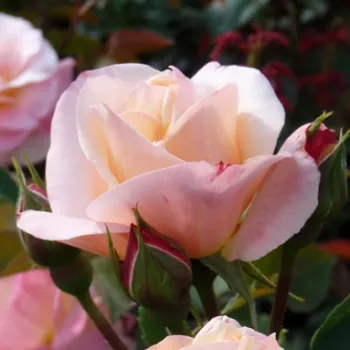
Peach-pink flowers with warm salmon and light orange tones; colour softens in strong sun yet stays richer in cooler spells, providing a gentle, pastel display across the flowering season. |
| Fragrance and aroma |
Strong, long-lasting fragrance with a slightly sweet character; the scent carries well both outdoors and in the vase, adding value for planting near paths, seating and cutting areas. |
| Rose hip characteristics |
Hip set is generally low as a result of the full, double flowers; where formed, hips are small, ovoid, 13–17 mm across and orange-red, adding modest late-season interest. |
| Resistance and hardiness |
Hardy to approximately −26 to −23 °C (RHS H7, USDA 5b); good black spot resistance, moderate tolerance to powdery mildew and rust; copes with moderate heat and short drought periods. |
| Horticultural recommendations |
Best in full sun with well-drained but moisture-retentive soil; medium maintenance with occasional pest and disease checks; recommended spacings from 35–65 cm depending on hedge, bed or specimen use. |
APRICOT QUEEN ELIZABETH offers romantic repeat flowering, strong fragrance and a neat, upright habit on a long-lived own-root framework that settles steadily into your garden; consider it if You want dependable beauty with simple care.