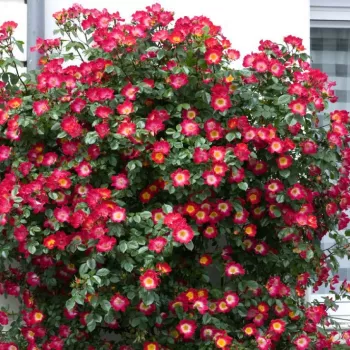
COCTAIL® – red-yellow park rose - Meilland
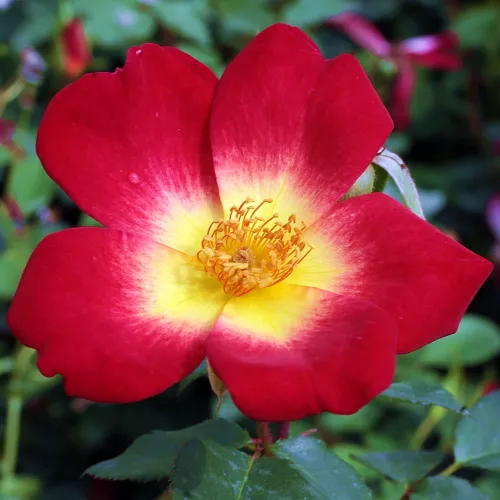
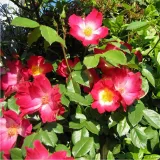
If You dream of a rose that fills your front garden with colour yet stays straightforward to look after, COCTAIL® is a classic choice that You can simply plant and enjoy. Its clusters of scarlet-red blooms with a golden-yellow centre create a vivid, “cocktail-glass” effect from early summer, bringing instant cheer to walls, arches and small garden structures. As a floribunda shrub that can be trained as a climber, it offers flexible use in Irish family gardens, coping reliably with our damp air and humidity while still rewarding You with repeat flushes. The flowers are single and open, with easy-access stamens that make it especially welcoming to visiting bees, so You can enjoy colour and movement together. Grown on its own roots, this 2‑litre plant settles in steadily and builds a long-lived, resilient framework that can regenerate from the base. Give it a sunny spot with reasonably good drainage, and within a few seasons You will see the natural development from strong roots in year one, through bushing-up in year two, to its full ornamental impact by year three.
Use cases
| Target area |
Reason |
| Front garden wall or house façade |
Trained on wires or a simple trellis, COCTAIL® quickly clothes a plain wall with upright, branching growth and dense, glossy foliage, giving a colourful welcome without fussy pruning – ideal for the time-poor homeowner |
| Small pergola or arch over a path |
Its moderate height and 120–180 cm spread make it perfect for light, airy coverage of arches in average-sized gardens, with cascades of red-and-yellow blooms at eye level to enjoy up close – a good match for the casual gardener |
| Mixed bed with cottage-garden feel |
Single, semi-wild-looking flowers and dark, glossy foliage blend beautifully with perennials and grasses, adding structure without dominating, for a relaxed rural or cottage style that suits the informal beginner |
| Pollinator-friendly family garden corner |
The open flower form and easily reached stamens make it highly attractive to bees, bringing movement and life to a play lawn edge or seating area while still looking neat and ornamental for a wildlife-aware family |
| Coastal or exposed urban front garden |
Good tolerance of sun and wind, combined with sturdy, upright canes, gives reliable flowering even where Atlantic weather brings frequent wet spells and high air moisture, reassuring the coastal gardener |
| Feature shrub in a narrow border |
Planted as a specimen at around 2 m spacing, it forms a vertical accent with long-lasting seasonal interest, ideal where You want one strong focal point instead of many plants, suiting the design-minded owner |
| Long-term, low-replacement planting |
As an own-root park shrub, it builds a stable framework that reshoots from the base if damaged, reducing the need for replacement and giving steady ornamental value over many seasons for the practical planner |
| Large container on patio or balcony |
In a 40–50 litre container with good compost, it offers vertical colour and dense foliage on balconies or small terraces, especially when underplanted with herbs or trailing plants, suiting the space-conscious urbanite |
Decorating ideas
- Cottage Archway Mix – Train COCTAIL® over a light metal arch and underplant with Gaura lindheimeri and dwarf Michaelmas daisies for a soft, drifting cottage look – ideal for fans of romantic, pollinator-friendly gardens
- Warm Welcome Wall – Cover a sunny front wall near the doorway and pair with pots of lavender and rosemary below to echo the scarlet and gold blooms – perfect for busy homeowners who want impact with little effort
- Family Seating Corner – Plant a small group behind a bench, weaving stems along a simple pergola, and mix with hydrangeas for summer colour where You relax – suited to families who enjoy easy, low-fuss flowers
- Urban Vertical Accent – In a large 40–50 litre container, guide stems up a narrow obelisk and combine with compact grasses for structure – great for balcony and terrace gardeners short on planting space
- Coastal Colour Ribbon – Line a fence with spaced COCTAIL® shrubs and interplant with variegated weigela for a durable, colourful boundary – appealing to coastal and rural gardeners wanting long-lived, simple planting
Technical cultivar profile
| Parameter |
Data |
| Name and registration |
Registered cultivar name MEImick, trade name COCTAIL® park shrub rose, ARS exhibition name Cocktail; floribunda shrub usable as a climbing, ornamental park rose for garden supports. |
| Origin and breeding |
Bred by Francis Meilland, Meilland International, France, from (Independence × Orange Triumph) × Phyllis Bide; introduced in 1957 and now recognised as a classic mid‑twentieth‑century garden rose. |
| Awards and recognitions |
Highly decorated: Rome Certificate 1956, Paris–Bagatelle first prize 1957, Orléans Gold Medal 1960; inducted into the WFRS Hall of Fame in 2015 as one of the World’s Favourite Roses. |
| Growth and structure |
Upright, vigorous shrub reaching about 200–300 cm high and 120–180 cm wide; dense, dark green glossy foliage on well-thorned canes that can be trained as a short climber on fences, arches or pergolas. |
| Flower morphology |
Single, flat flowers in small clusters, about 0.5–1.5 inches across, with 5–12 petals; remontant habit gives repeat flowering, though later flushes are lighter than the first; good self-cleaning of spent blooms. |
| Colour and phenology |
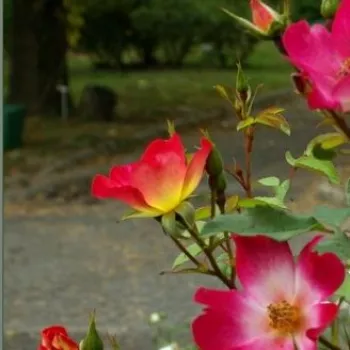
Striking bicolour: vivid scarlet-red outer petal zones with a sharp golden-yellow eye; colours soften to salmon and creamy lemon as blooms age, with some fading in strong sun but a consistently lively overall effect. |
| Fragrance and aroma |
Fragrance is very weak and only lightly fresh, so it is chosen mainly for visual effect and pollinator value rather than scent; suits situations where strong perfume is not desired near windows or seating. |
| Rose hip characteristics |
Produces small, spherical red hips around 7–13 mm in diameter, usually in moderate quantities; they add a discreet late-season accent and may be left for wildlife or removed to maintain a tidier appearance. |
| Resistance and hardiness |
Hardy to about −26 to −23 °C (RHS H7, USDA 5b, Swedish zone 4); tolerates heat well but appreciates watering in long dry spells; disease resistance is moderate, with occasional protection needed in high-pressure years. |
| Horticultural recommendations |
Best in sun or light partial shade with reasonable drainage; medium maintenance, needing shaping, tying-in and, at times, plant protection; recommended spacing from 125–210 cm depending on hedge, mass or specimen use. |
COCTAIL® gives vibrant red-and-yellow flowers, flexible shrub-or-climbing use and long-lived own-root resilience, making it a reliable choice if You want a colourful feature that stays manageable over the years.