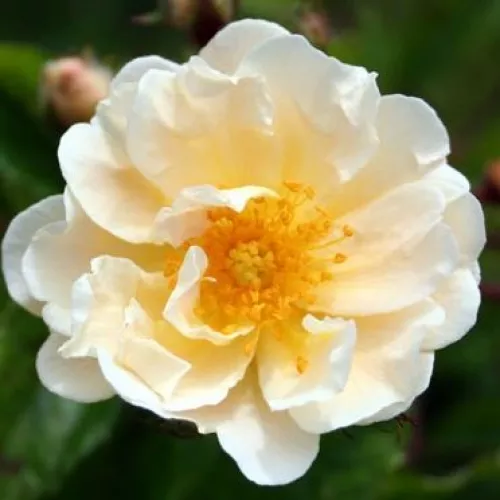
Initially deep golden yellow, fading to a buttery yellow in sunlight. - historical, old garden rose - strong, well-scented rose - fresh, fruity character
– Strong, fresh fruity fragrance for the garden
– Resistant to mildew, black spot and rust
– Vigorous climbing growth for arches and walls
– Soft yellow clusters that lighten to cream
– Low-maintenance with good self-cleaning Gné speisialta: Beagnach gan dealga, oiriúnach do láimhseáil éasca.
Consistent quality – Value-based choice
pharmaROSA® ORIGINAL 2-litre own-root potted rose
18,30 €
4(6026)
Goldfinch – yellow historic rambler rose
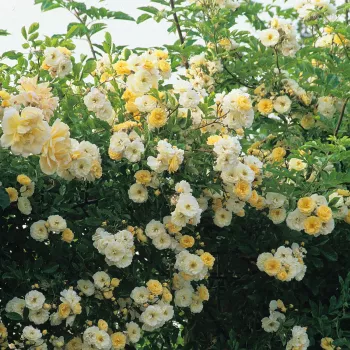
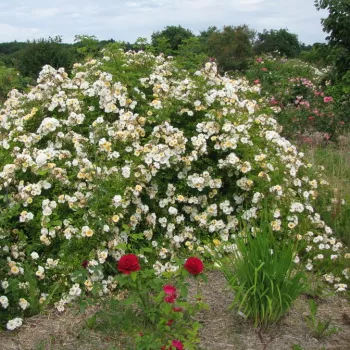
If You dream of a romantic, easy-going rambler rose that simply gets on with growing in Irish weather, Goldfinch is a graceful historic choice. Its semi-double clusters of small, lemon-yellow flowers soften to cream, creating a light, cottage-style shower of colour along fences, pergolas and house walls. Once established, it copes well with typical Irish rain and wind and appreciates soil prepared to manage heavier moisture where needed for drainage. With low maintenance needs and good disease resistance, You can enjoy its flowering display without complicated spraying routines – ideal for busy gardeners. As an own-root plant, it develops into a long-lived, stable shrub that recovers well from pruning and weather wear, giving dependable structure year after year. Its partially pollinator-friendly, open-centred blooms and barely thorny shoots make it a pleasant partner in narrow paths and family gardens, while the strong, fruity fragrance adds an old-world charm. In a 2-litre pot, this historic rambler arrives well rooted and ready to settle; think roots in year one, framework in year two and full ornamental effect by year three. Use it to frame cottage-style entrances, soften sheds or create an airy privacy screen. Flowering once in early summer, it rewards You with a concentrated season of blossom that feels special every year, with minimal effort for You and a long, reliable life in Your garden.
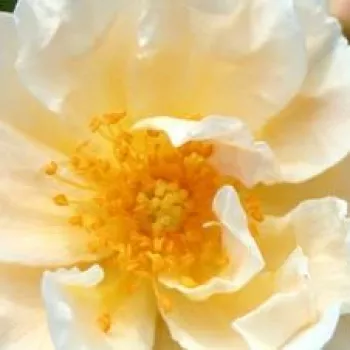
Goldfinch rose blossom with a fresh, fruity fragrance.
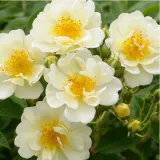
Goldfinch showing several opening stages and colour shifts on the same cluster.
Use cases
Target area
Reason
Front-garden arch or pergola near the entrance
Ideal for welcoming entrances where You want a romantic summer display without constant work. Its once-a-year flush of yellow flowers and low maintenance needs suit those preferring a dependable, easy-care feature, perfect for the busy beginner
Family garden fence or boundary screen
Clothing long fences is straightforward thanks to its vigorous climbing habit and good disease resistance, so it fills space with greenery and seasonal colour rather than chores. Barely thorny canes make it easier to manage beside paths for the family gardener
Cottage-style planting with mixed perennials
The airy clusters of small, semi-double blooms pair beautifully with looser cottage companions like Echinacea or Verbena, creating a soft, nostalgic look. Its historic character adds depth and story to older homes and rural plots for the romantic traditionalist
Lightly shaded house wall or garage façade
Performs reliably on walls that receive only part-day sun, bringing colour and scent where many roses struggle. Suitable for partial shade, it brightens north-east or north-west aspects with a restrained workload for the urban homeowner
Small group of 1–3 plants on a long pergola
Planting a short row allows the vigorous growth to intertwine and form a continuous tunnel of summer flowers. Good self-cleaning helps keep the structure tidy, so You spend less time deadheading for the time-poor gardener
Pollinator-friendly corner or wildlife-friendly border
Semi-double, open blooms provide accessible stamens that attract bees and other beneficial insects during the main flowering period, adding life and movement to the garden while still looking refined for the nature lover
Coastal or exposed suburban sites
Once established with sensible soil preparation, it handles typical Irish wind and wet weather, especially in gardens where improving heavier soils helps manage excess moisture and protects roots from waterlogging, reassuring the coastal gardener
Large container on balcony or patio (40–50 litres minimum)
In a substantial container with a trellis, its long canes create vertical interest in smaller spaces. The own-root plant gradually builds a balanced framework and can regenerate well after pruning, supporting a long-lived display for the compact-space owner
Decorating ideas
COTTAGE ARCHWAY – Train Goldfinch over a wooden arch with Echinacea below for a soft, vintage entrance – perfect for lovers of classic rural cottage gardens
SOFT FENCE CURTAIN – Let its barely thorny canes drape along a front fence, underplanted with tall verbena for a light, see-through privacy screen – ideal for family-friendly front gardens
SCENTED SIDE PATH – Guide stems along wires beside a side path, where the strong fruity fragrance greets You on summer evenings – great for busy homeowners who still want evening atmosphere
HISTORIC FEATURE WALL – Combine Goldfinch on a sunny wall with old-style hydrangeas in front to echo period homes and farmhouses – suited to fans of heritage and character planting
SMALL PATIO PERGOLA – In a 40–50 litre container, send shoots up a compact pergola with lavender at the base for colour and scent – ideal for urban balcony and terrace gardeners
Technical cultivar profile
Property
Data
Name and registration
Registered cultivar name Goldfinch, historic old garden rambler from the Hybrid Multiflora and Polyantha group; commercial name Goldfinch Historic rose Goldfinch, ARS exhibition name Goldfinch.
Origin and breeding
Bred by George Paul Jr., Paul & Son; Cheshunt Nurseries, United Kingdom. Parentage: ‘Hélène’ × unknown seedling. Introduced 1907, historic, unregistered variety later distributed by Hazlewood Bros. in Australia.
Growth and structure
Vigorous climbing rambler reaching about 320–500 cm high, spreading 180–280 cm. Moderately dense, glossy dark green foliage, with very few prickles, ideal for training on arches, pergolas, walls and fences in medium gardens.
Flower morphology
Semi-double, cupped to flat-opening blooms of small size (about 0.5–1.5 in), borne in large clusters. Petal count roughly 13–25 per flower, with good self-cleaning, as spent petals drop naturally from the trusses.
Colour and phenology
Initially deep golden to lemon yellow, quickly softening to buttery and creamy tones, often near white by the end of flowering. Non-remontant, giving one abundant early-summer flush that creates a concentrated, showy display.
Fragrance and aroma
Strong, fresh fruity fragrance typical of many old garden ramblers, noticeable along paths and seating areas. Semi-double, open flowers provide both visual charm and scent, enhancing cottage-style and traditional planting schemes.
Rose hip characteristics
Produces moderately formed, spherical red hips about 6–9 mm in diameter after flowering, adding subtle autumn interest and potential wildlife value without becoming visually dominant on the plant.
Resistance and hardiness
Good general disease resistance; rated resistant to powdery mildew, black spot and rust. Hardy to around -15 to -12 °C (RHS H6, Swedish Zone 2, USDA 7b). Tolerates moderate heat and short dry spells with watering in longer droughts.
Horticultural recommendations
Low-maintenance rambler for arches, pergolas, fences, walls and as a solitary specimen. Suitable for partial shade; allow 120–220 cm spacing depending on use. For mass planting, about 0.51–0.59 plants per m² is recommended.
Goldfinch offers low-maintenance yellow summer flowering, vigorous vertical coverage and a strong fruity scent, while its own-root character supports long-term regeneration and reliability, making it a reassuring choice if You are considering this rose.
Detailed product attributes
Product Identification Data
Product Name:
GOLDFINCH – yellow historic old garden rose - Paul
Product Type:
pharmaROSA® ORIGINAL - 2-litre own-root potted rose
Our product is a rose grown with unique pharmaROSA® cultivation technology!
2 litre, own-root, potted rose.
With shoots appropriate to the season.
With roots thoroughly interwoven through the growing medium.
Quality in line with the requirements of the E.N.A. (European Nurserystock Association).
In unique packaging that prevents damage.
Can be planted during frost-free periods.
True-to-type rose plant with an individual identifier.
The pharmaROSA® own-root potted rose is a well-rooted plant that supports reliable establishment when planted and cared for properly, so it can be planted whenever the soil is not frozen.
Stock: several varieties and several stages of development in a short stock section.Shoot system: intensive growth of fresh basal shoots on a young plant.Root system: presentation of the strong root system interwoven through the growing medium with the pot removed.Balance: mature plant where the development of the root system and the shoots is in harmony.
Information about the videos
The video series is not a “seasonal showcase”, but makes the essence of pharmaROSA® own-root production tangible: how the plant is built, what the root system is like and how the shoots renew themselves. The footage was therefore taken at different times, showing plants at different stages of development, so mixed leaf coverage or differing growth stages may appear in the videos. This is not a “sample” of the batch delivered, but an illustration of how the technology works. The current condition of the rose available to order — typical of the given period and similar to what you can expect to receive in the parcel — is shown at the top of the product page.
Pages for private customers Garden roses for the family garden, with minimal care → ORIGINAL® Premium garden roses – instant impact, a truly showpiece garden → EXTRA® Pages for professionals and private customers Roses for public spaces – large areas, sustainable maintenance → NATURAL® Roses for projects – hedge and row planting, fast implementation → RAPID® For professional partners only Production – propagation material for garden roses, wholesale → NEONATAL®
Company details
PharmaRosa Ltd. Company registration number: 01-09-717479 VAT number: 13075314-2-43 Plant health registration no.: HU130721 Bank account (IBAN): HU85117631891388688400000000 BIC (SWIFT): OTPVHUHB Bank name: OTP Bank Nyrt.