HORJASPER – red climbing rose – Horner
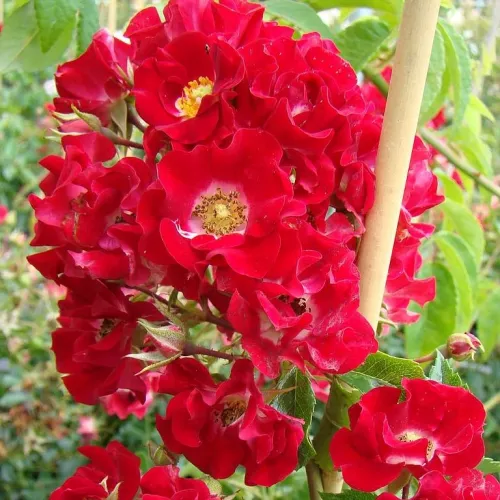
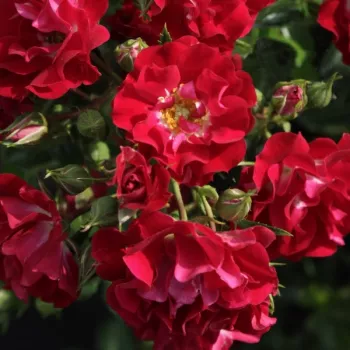
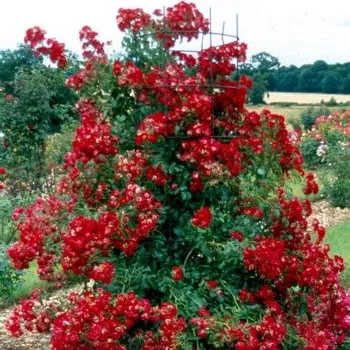
HORJASPER is a repeat-flowering climbing rose that gives You generous clusters of bright scarlet-red blooms with a white eye from early summer well into autumn, creating an instantly colourful, cheerful presence on walls, fences and arches. Its semi-double flowers appear in impressive clusters, then drop their petals cleanly so the plant stays neat with very little deadheading – perfect if You like things looking tidy without constant effort. As an own-root climber it builds a naturally balanced framework that can be enjoyed for decades, offering reassuringly long-term value once it has settled in. Year one focuses on roots, year two on stronger shoots, and by year three You see its full ornamental impact along the chosen support. Dense, dark green, glossy foliage gives a rich backdrop that looks healthy and lush even when not in flower, especially in typical Irish summers with frequent rain and the need to cope with heavy soil and good drainage in a wet climate. With reliable repeat flowering and a proven track record in trials, HORJASPER rewards a bit of care with a dramatic, romantic display around your home.
Use cases
| Target area |
Reason |
| Front-garden arch or rose tunnel |
Ideal if You want a welcoming entrance that looks impressive without needing intricate pruning skills. HORJASPER repeats well on an arch, covering it with clusters of red and white-eyed blooms over a few seasons, building year by year to a full display for beginners |
| South- or west-facing house wall |
Along a sunny wall HORJASPER’s vigorous canes and dense foliage form a living curtain, giving strong colour and good heat tolerance once established. With regular feeding and tying-in, it becomes a long-lived vertical feature that suits time-pressed homeowners |
| Garden fence in a family garden |
Use it to soften boundaries and screen views; the self-cleaning clusters keep the fence line looking smart with minimal deadheading. Space plants along the run and guide the canes horizontally to maximise flowering for busy families |
| Rural cottage-style pergola or seating area |
Its rambling character and vivid red clusters with a white eye fit beautifully into informal cottage schemes. Allow some canes to arch naturally over a pergola or bench, adding romance and seasonal shade that appeals to cottage-garden enthusiasts |
| Large container on a patio or balcony |
Planted in a minimum 40–50 litre container with a sturdy obelisk or trellis, HORJASPER can bring vertical colour to paved spaces and coastal balconies, coping well once rooted in and suiting space-limited gardeners |
| Mixed border with perennials and shrubs |
Train it up an obelisk or pillar within a mixed border where its dark green foliage and repeat red flowering contrast nicely with perennials such as cranesbill or ornamental grasses, giving height and structure for creative planters |
| Screening for sheds or utility corners |
The robust growth and dense foliage quickly disguise less attractive structures; guided along wires, it forms a colourful green screen that flowers repeatedly, a practical solution for visually improving functional corners for householders |
| Rose arch linking garden “rooms” |
Use HORJASPER on a pair of arches to mark a transition between lawn and vegetable patch; its reliable remontant flowering and ability to establish steadily even in our wetter Irish conditions with attention to drainage suit long-term-thinking gardeners |
Decorating ideas
- Cottage Entrance Arch – Train HORJASPER over a metal arch with cranesbill at the base for a soft, spilling effect – ideal for lovers of informal cottage-front gardens
- Warm Wall Cascade – Tie the canes along horizontal wires on a sunny wall, letting the flower clusters cascade between them – suitable for homeowners wanting strong colour without complex design
- Patio Pillar Pot – Plant one rose in a 40–50 litre terracotta tub with a slim pillar support and underplant with low herbs – perfect for balcony and small-patio gardeners
- Pergola Retreat – Cover a simple timber pergola beside a seating area, combining HORJASPER with late-flowering clematis for layered colour – appealing to those creating a romantic corner to relax in
- Boundary Softening Fence – Space plants along a timber fence and guide canes sideways, filling gaps with ivy or shade-tolerant perennials – good for families wanting privacy with a softer, greener feel
Technical cultivar profile
| Parameter |
Data |
| Name and registration |
Repeat-flowering rambler and climbing rose; registered as HORjasper, marketed as Horjasper Climbing rose HORjasper, exhibition name Rambling Rosie. Belongs to the climbing rose collection and exhibition climbing category. |
| Origin and breeding |
Bred by Colin P. Horner in the United Kingdom (2001) from Super Excelsa × (Baby Love × Golden Future). Introduced and registered in 2005, with initial distribution through Warner’s Roses in the UK. |
| Awards and recognitions |
Gold Standard Rose Trials Gold Standard Award (2007), RHS Award of Garden Merit (2012), Glasgow Rose Trials Golden Prize (2010), Hague Rose Trials Bronze Certificate (2010), marking strong garden performance. |
| Growth and structure |
Vigorous climbing habit, typically 300–500 cm high with a 100–220 cm spread. Forms dense, dark green glossy foliage on strongly prickly shoots, suited to walls, fences, arches and pergolas with suitable support and training. |
| Flower morphology |
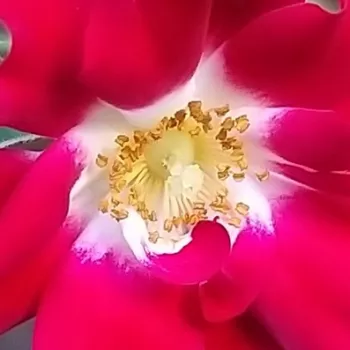
Semi-double, flat blooms with approximately 13–25 petals, borne in large clusters. Small flowers (about 0.5–1.5 inches) open repeatedly through the season, with good self-cleaning as most spent petals fall naturally. |
| Colour and phenology |
Intense, clear scarlet-red flowers with a defined white eye. Buds open bright scarlet-red, then fade to carmine-red with a paler, almost white centre toward the end. Colour retention is very good, giving long-lasting visual impact. |
| Fragrance and aroma |
Very faint rose scent, generally only noticeable at close range and in warm, still weather. Semi-double clusters offer partial pollinator appeal, with stamens only partly accessible, so pollinator visits are occasional rather than constant. |
| Rose hip characteristics |
Forms spherical orange-red hips about 6–10 mm across in moderate quantities, adding a light decorative effect in late season without overwhelming the plant; hips may be removed if not desired. |
| Resistance and hardiness |
Hardy to about -21 to -18 °C (H7, USDA 6b, Swedish zone 3). Heat tolerant and moderately drought-tolerant once established. Susceptible to fungal diseases, especially rust, so regular monitoring and plant protection are important. |
| Horticultural recommendations |
Suited to arches, walls, fences, pergolas, pillars and large containers. Allow 140–240 cm spacing depending on use, with 0.4–0.5 plants/m² for mass planting. Needs regular feeding, watering, tying-in and disease management for best results. |
HORJASPER offers dramatic repeat red flowering, dense glossy coverage and long-lived own-root reliability for arches, walls and large containers; consider it if You want a striking climbing feature that repays your care over time.