ISKRA™ – scarlet-red climbing rose - Meilland
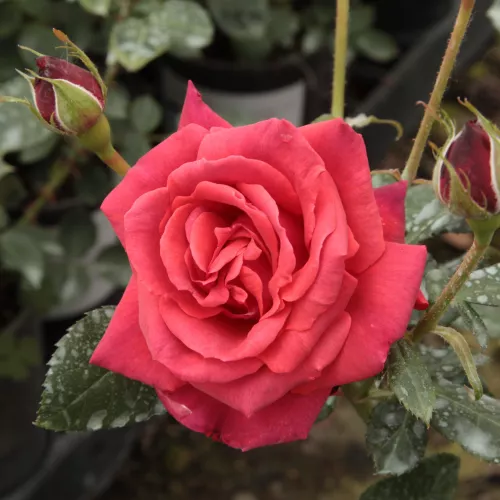
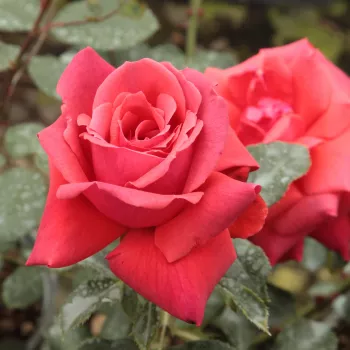
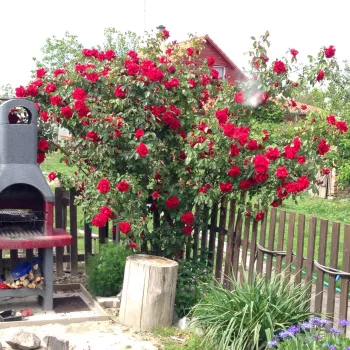
If You dream of a romantic climbing rose that You can simply plant and let it knit itself into your garden, ISKRA™ Rambling rose MEIhaiti is a reliable choice for pergolas, fences and cottage-style walls. This semi-double, scarlet-red rambler covers itself once a year in a spectacular flush of blooms, then decorates the garden with neat orange-red hips for the rest of the season. Its medium maintenance needs suit Irish gardens where drainage matters in heavier soils and wetter weather, while own-root strength supports a long-lived, stable framework of canes. Over time You will see the classic development arc: in year one it focuses on roots, in year two it pushes strong new shoots, and by year three it shows its full ornamental value with a mature climbing shape. The cupped, coral-tinted flowers sit among slightly glossy foliage on a moderately thorny, creeping framework that is easy to tie in along fences and arbours. With good colour retention, medium disease resistance and dependable winter hardiness, ISKRA™ helps You create a long-lasting, low-fuss climbing feature that simply works in a family garden.
Use cases
| Target area |
Reason |
| Front-garden pergola framing the entrance |
Forms a tall, creeping framework that readily clothes a pergola with a single, dramatic flush of scarlet-red flowers, giving a welcoming cottage-garden feel without demanding complex pruning, ideal for the busy homeowner gardener |
| Sunny fence in a small to medium back garden |
Climbs 240–360 cm and spreads up to 260 cm, making it well suited to covering standard Irish garden fences, while its own-root base builds a long-lived, replaceable cane system that copes well with wetter seasons and heavier soils households |
| Rose-covered arbour or walk-through arch |
Creeping growth habit and flexible canes are easy to fan out over arches and arbours, creating a romantic tunnel of colour in early summer, yet requiring only occasional tying-in and seasonal tidy-up to stay in shape couples |
| Rural cottage-style wall planting |
The once-a-year mass flowering followed by orange-red hips suits traditional cottage-garden looks, offering months of visual interest with relatively modest care, fitting older stone walls and country boundaries particularly well cottage-owners |
| Mixed border backdrop behind perennials |
Works as a vertical accent behind perennials such as bearded iris and white sagebrush, where the scarlet flowers and bronze-green foliage provide seasonal drama, then recede to a textured green screen for the rest of the year enthusiasts |
| Family play garden boundary screen |
Moderately dense, slightly glossy foliage creates a softer visual screen along boundaries without becoming an impenetrable thicket, while medium prickliness encourages respect for the plant but still allows manageable maintenance and training families |
| Coastal or exposed site with sheltering structure |
Best sited where a fence or wall can break strong Atlantic winds and help manage heavier, wetter soils and tricky drainage, so the own-root plant can establish steadily and build a resilient, well-anchored climbing framework coast-dwellers |
| Low-fuss rose feature for beginners |
Non-remontant flowering keeps pruning tasks straightforward, while medium disease resistance and hardy roots reduce specialist care; once established, the plant focuses on reliable structure rather than constant attention, building confidence for beginners |
Decorating ideas
- COTTAGE ARCH – Train ISKRA™ over a wooden arch, underplanting with bearded iris and hardy geraniums for a classic cottage entrance – ideal for lovers of nostalgic, storybook-style gardens
- SCARLET FENCE – Run its canes along a sunny timber fence, weaving through rosemary and lavender at the base to soften the line – suited to homeowners wanting easy structure and summer drama
- WALLED WALKWAY – Let the creeping shoots fan out along a warm house wall, with pots of hydrangea at ground level to extend the flowering show – perfect for compact front gardens
- WILDLIFE CORNER – Use it on an arbour near a seating area, combining with late-flowering perennials so the hips and semi-double blooms add seasonal interest for birds and insects – good for nature-friendly gardeners
- RURAL HEDGE – Space plants in a loose row along a boundary, tying stems to posts and wires for a rustic flowering barrier that needs only occasional shaping – great for country cottages and weekend retreats
Technical cultivar profile
| Parameter |
Data |
| Name and registration |
Registered as MEIhaiti, marketed as Iskra™ Rambling rose MEIhaiti, exhibition name Sparkling Scarlet; climbing hybrid Wichurana rambler type within the climbing rose commercial group. |
| Origin and breeding |
Bred by Marie-Louise Meilland in Germany, around 1969; introduced by Meilland International SA (France) circa 1971, with parentage unknown but selected for ornamental climbing performance. |
| Growth and structure |
Large, creeping climber reaching about 240–360 cm high with 150–260 cm spread; moderately thorny canes, moderately dense, slightly glossy bronze-green foliage, suited to pergolas, arbours and walls. |
| Flower morphology |
Semi-double, cupped blooms with a medium high-centred form, 13–25 petals in clustered inflorescences; medium-sized flowers approximately 4–7 cm across, on arching, trainable shoots. |
| Colour and phenology |
Bright scarlet-red with slight orange tone; buds deep velvety red, opening fiery then softening to coral-red before fading; colour retention good, flowering once per season in a strong main flush. |
| Fragrance and aroma |
Fragrance of very weak intensity with a light rosy character; scent noticeable only at close range, so it complements seating areas where colour impact is prioritised over strong perfume. |
| Rose hip characteristics |
Moderately abundant, spherical hips about 16–24 mm, maturing to an orange-red shade; add late-season decorative interest and potential wildlife food value after flowering finishes. |
| Resistance and hardiness |
Medium general disease resistance: resistant to black spot, medium against powdery mildew and rust; winter hardy to around −15 to −12 °C (RHS H6, Swedish zone 2, USDA zone 7b). |
| Horticultural recommendations |
Best in full sun with reasonable drainage; plant at 140 cm spacing for fences or 220 cm as a specimen; tie in new canes regularly, prune after flowering, and use a minimum 40–50 litre container if grown in a pot. |
ISKRA™ Rambling rose MEIhaiti offers dramatic scarlet flowering, reliable hardiness and a long-lived own-root climbing framework that settles into family gardens with modest care, so You can choose it with confidence for your next planting.