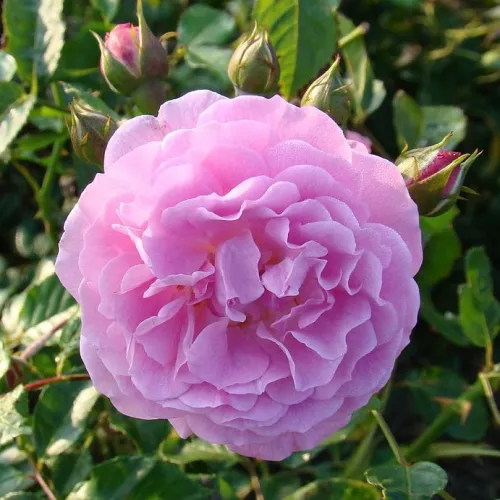
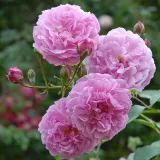
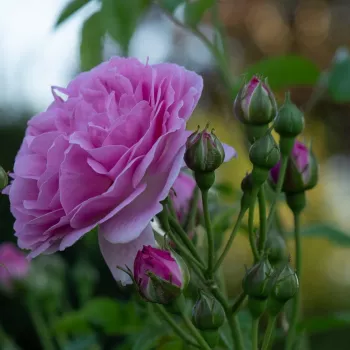
Lavender Lassie – park shrub rose in pink-lilac shades
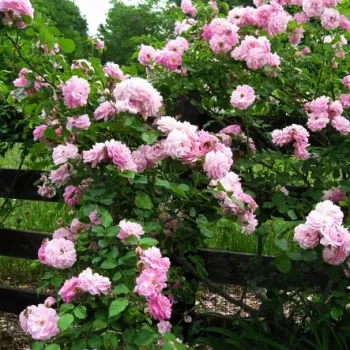
If You are looking for a romantic yet straightforward shrub rose for an Irish family garden, Lavender Lassie is a reliable choice that rewards You with clouds of soft lavender-pink blooms and a strong, sweet-musky fragrance. Its vigorous, bushy habit quickly builds a leafy framework that fits cottage-style beds, hedges and pergolas, while remaining easy to keep in shape. This own-root plant settles in steadily, forming a long-lived, regenerating structure that copes well with our damp climate and the need for decent drainage on heavy clay. In its first year it focuses on roots, in the second on stronger shoots, and from the third year it delivers full colour and flower impact. The semi-double, cupped clusters are naturally self-cleaning, so old petals fall away with little effort from You, leaving more time to enjoy its repeat flowering along paths, front gardens and sunny house walls.
Use cases
| Target area | Reason |
|---|
| Front garden focal shrub |
Vigorous, bushy habit builds a substantial shrub that anchors a front garden, giving height, presence and year-round structure without fussy pruning; ideal for those who want impact but not intricate shaping for the busy home gardener |
| Flower bed with long flowering season |
Strongly remontant, with generous second flushes, so beds stay colourful over a long season once the plant has moved beyond its root-building first year and into full performance by about the third for the patient beginner |
| Cottage-style hedge or informal screen |
Height to around 150–230 cm and dense, glossy foliage allow Lavender Lassie to create a soft, semi-formal hedge that screens views while keeping a romantic, rural feel, suiting those who prefer relaxed structure for the cottage-garden owner |
| Pergola, arch or pillar planting |
Flexible, vigorous shoots and clustered flowers can be lightly tied to supports, giving a loose, arching effect over pergolas or pillars without needing the strict training of a climber, fitting gardeners who like simple, forgiving solutions for the casual improver |
| Part-shade side garden or wall |
Performs well in partial shade, where its pastel mauve-pink tones hold their colour better than in strong sun, making it useful along north-east or north-west aspects that many roses find challenging for the townhouse resident |
| Low-maintenance mixed border |
Good self-cleaning flowers drop their petals cleanly, keeping borders tidy with minimal deadheading, so it blends well among perennials and shrubs when You want seasonal colour but have limited time for detailed upkeep for the time-poor gardener |
| Structure plant in long-term plantings |
As an own-root shrub, it develops and renews from its own base over time, supporting a long planting life with less worry about graft failure or replanting, ideal for those planning stable, enduring garden frameworks for the long-term planner |
| Wind-exposed coastal or open garden bed |
Strong, bushy framework and H7 hardiness cope well with open, breezy positions where sturdy shrubs are needed, provided soil is prepared to manage heavier, wetter ground and protect against persistent winter wet for the coastal homeowner |
Decorating ideas
- Cottage hedge charm – Plant a loose hedge of Lavender Lassie along a front boundary, weaving through Alchemilla mollis and old-fashioned wallflowers for soft, shifting colour – ideal for lovers of traditional cottage gardens
- Romantic pergola walk – Train a few stems onto a simple wooden pergola and underplant with lady’s mantle and hardy geraniums to create a scented walk from gate to door – perfect for homeowners who want a welcoming entrance
- Pastel mixed border – Combine Lavender Lassie with blue and cream perennials, such as garden honeysuckle on a trellis behind it and low catmint at its feet – suited to gardeners seeking gentle, harmonious tones
- Part-shade side retreat – Use it along a side path receiving only morning or late-afternoon light, teamed with ferns and hostas, where its colour holds beautifully – great for making use of tricky, less-sunny strips
- Statement specimen – Give a single shrub space in the lawn or at a path junction so its arching, blossom-laden branches become a focal point – ideal for those wanting a standout feature with simple care
Technical cultivar profile
| Property | Data |
|---|
| Name and registration |
Lavender Lassie, a shrub Hybrid Musk park rose marketed as a park-shrub type; ARS approved exhibition name Lavender Lassie; unregistered cultivar in terms of formal registration number. |
| Origin and breeding |
Bred by Reimer Kordes (W. Kordes’ Söhne, Germany) from ‘Hamburg’ × ‘Madame Norbert Levavasseur’; bred in Germany in 1956 and first introduced commercially in 1960 via Roy H. Rumsey Pty. Ltd. in Australia. |
| Awards and recognitions |
Recipient of the National Rose Society Trial Ground Certificate in the United Kingdom in 1959, highlighting its ornamental and garden performance qualities at formal rose trials of the period. |
| Growth and structure |
Vigorous, bushy shrub reaching about 150–230 cm high with a 90–150 cm spread; moderately thorny shoots carry dense, dark green, glossy foliage that creates strong structural presence in beds, hedges and informal screens. |
| Flower morphology |
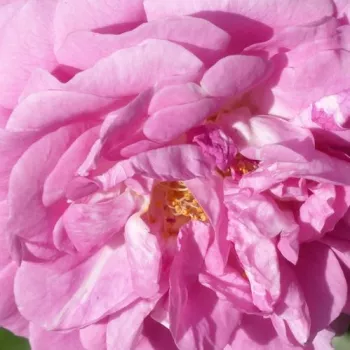
Semi-double, cupped blooms with approximately 13–25 petals; medium-sized flowers borne in large, showy clusters that repeat strongly through the season; good self-cleaning means many spent blooms drop their petals naturally. |
| Colour and phenology |
Delicate, pastel mauve-pink with subtle lilac undertones; buds medium mauve-pink, flowers open lavender-pink with paler outer petals, then fade towards soft pink and near-whitish centres, with best colour retention in partial shade. |
| Fragrance and aroma |
Strong, sweet musky scent typical of Hybrid Musk roses, long-lasting on the shrub and suitable for cutting; fragrance carries well in still evening air, adding sensory value near paths, terraces or seating areas. |
| Rose hip characteristics |
Occasionally produces small, ellipsoid orange-red hips approximately 10–14 mm in diameter, adding a modest decorative element in late season without significantly affecting the plant’s main flowering display. |
| Resistance and hardiness |
Hardy to about −26 to −23 °C (RHS H7, USDA 5b, Swedish zone 4); disease resistance moderate for powdery mildew, black spot and rust, benefiting from reasonable air flow and standard preventative care in humid conditions. |
| Horticultural recommendations |
Recommended as a specimen, in flower beds, as a hedge or on pergolas, and for cutting; suitable for partial shade; allow around 100–180 cm between plants depending on use, and ensure regular watering during prolonged dry spells. |
Lavender Lassie offers long-season flowering, a strong sweet-musky scent and a durable own-root shrub framework that matures steadily over the years, making it a sound choice if You want a beautiful rose that remains manageable and rewarding to live with.