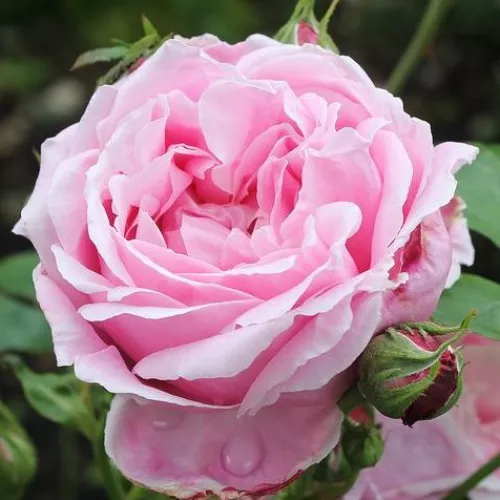
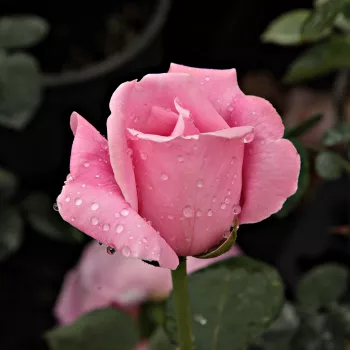
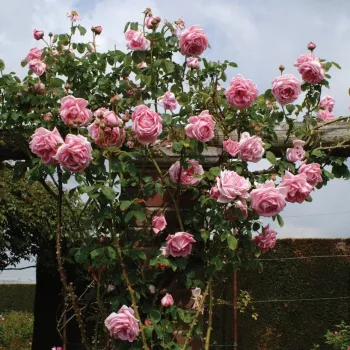
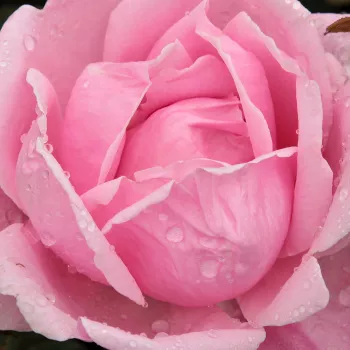
Medium pink with a silky sheen. - hybrid tea rose - strong, long-lasting scented rose - scent description not available
– Large, elegant hybrid tea blooms
– Strong, long-lasting classic rose scent
– Reliable repeat flowering through the season
– Resistant to black spot and mildew
– Hardy to -26 °C for cold climates Special feature: Historic 1890 French fashion-salon rose, ideal for romantic beds and bouquets.
Customer-centred focus – Year-round
pharmaROSA® ORIGINAL 2-litre own-root potted rose
18,30 €
3(4992)
MADAME CAROLINE TESTOUT – pink hybrid tea rose – Pernet-Ducher
If You dream of a romantic, classic rose that still stays reliable in Irish gardens, MADAME CAROLINE TESTOUT is an easy-care hybrid tea that thrives even where soils are heavy and wetter than ideal. Its upright, bushy habit and long, straight stems make it wonderfully elegant at the front of beds or as a feature by your front door, while the large, goblet-shaped blooms bring a distinctly romantic cottage feel. The medium pink flowers open from vivid buds, then gently fade to soft pastels, giving Your garden a constantly changing, colourful display from early summer onwards. Strong, long-lasting fragrance means You can cut stems for the vase without losing garden impact, and the variety’s good disease resistance keeps maintenance simple and manageable. As an own-root rose in a 2-litre pot, it will first focus on roots, then build bushy shoots in year two, and by year three it typically reaches its full ornamental value, settling into a long-lived, enduring presence in Your garden.
Madame Caroline Testout, a pink hybrid tea rose in full bloom.
Madame Caroline Testout rose in full bloom, showing uniform pink flowers with a subtle silvery edge.
Use cases
Target area
Reason
Front garden feature rose
Upright, bushy growth and large, classic hybrid tea blooms create an immediate focal point beside paths, gateways or the front door, giving a neat, welcoming look without complex pruning – ideal for the busy urban or village-front gardener who wants simplicity
Romantic cottage-style flowerbed
The soft medium-pink flowers that fade to pastel tones fit perfectly with traditional cottage-planting schemes, combining well with catmint, foxgloves or sweet alyssum while still remaining tidy and structured – perfect if You like a relaxed look but prefer order
Cut-flower row in a small garden
Long, straight stems with large, double, goblet-shaped blooms and strong, lasting fragrance make this rose excellent for home-cut bouquets, allowing You to enjoy the colour and perfume indoors as well as outside – a good choice for home florists seeking reliability
Low-maintenance mixed border
Good resistance to common rose diseases means fewer sprays and less fuss, so it sits comfortably amongst perennials and shrubs in family borders, keeping its leaves and flower display credible through damp Irish summers – ideal for gardeners who appreciate ease
Own-root long-term planting
As an own-root rose, the bush gradually forms its natural shape in its final place, recovering better from winter or pruning and providing stable, repeat flowering over many years, rewarding anyone planning a garden they can enjoy for the long term
Small group planting (1–3 shrubs)
Planting a small cluster along a path or in a front bed builds a rounded, elegant display, while the recommended spacing helps air flow and reduces disease issues, making it easy to maintain a coherent look in modest-sized family gardens for those valuing balance
Container rose on patio or balcony
In a 40–50 litre container with good drainage, its upright habit and repeat-flowering nature give a long season of colour and scent on patios, balconies or at the back door, particularly where ground soil is too heavy or wet – a smart solution for space-conscious owners
Classic rose focus in clay or heavier soils
This variety copes well when planted into improved heavy clay, provided drainage is helped with grit and organic matter, making it suitable for many Irish gardens where soils hold water yet still suit this sturdy, upright bush – reassuring for gardeners dealing with clay
Decorating ideas
Cottage Front Path – Line a short garden path with two or three bushes, underplant with sweet alyssum and dwarf lavender for fragrance and soft edging – for homeowners who want a pretty, traditional welcome.
Romantic Cutting Corner – Create a small cutting patch with MADAME CAROLINE TESTOUT, backed by white Liatris and soft grasses to provide foliage and contrast for bouquets – suited to hobby florists and flower-arranging fans.
Formal Entry Pair – Plant one rose each side of your front door in 40–50 litre pots, combining with trailing ivy and seasonal bedding for a smart, symmetrical look – ideal for townhouses and neat urban entrances.
Soft Park-Style Border – Use as a repeating accent along a mixed shrub and perennial border, interplanted with hydrangeas and catmint to give structure and long colour – for families wanting elegance with low weekly upkeep.
Country Cottage Focus – Place a single specimen near a bench or sitting area, framed with foxgloves and old-fashioned perennials to evoke a rural cottage feel – perfect for those who like nostalgic, fragrant garden corners.
Technical cultivar profile
Property
Data
Name and registration
Hybrid tea rose, trade name MADAME CAROLINE TESTOUT – pink hybrid tea rose – Pernet-Ducher; ARS exhibition name MADAME CAROLINE TESTOUT; unregistered cultivar for garden and cut-flower use.
Origin and breeding
Bred by Joseph Pernet-Ducher, Pépinieres Pernet-Ducher, Lyon, France; cross of ‘Madame de Tartas’ × ‘Lady Mary Fitzwilliam’; introduced by Pernet-Ducher in 1890 as a classic hybrid tea.
Growth and structure
Upright, bushy hybrid tea with dense, mid-green, slightly glossy foliage; moderate prickles; height around 100–140 cm, spread 70–110 cm, forming a well-filled shrub suitable for beds and specimen use.
Flower morphology
Large, double, cup to goblet-shaped blooms with 26–39 petals; solitary flowers on stems, ideal for cutting; remontant habit gives a generous second flush of flowers after the main early-summer display.
Colour and phenology
Medium pink flowers with a silky sheen; buds are deep vivid pink, opening to uniform pink with a subtle silvery tint, then fading to pale pastel pink, especially in strong sun; colour lasts longer in cooler conditions.
Fragrance and aroma
Strong, long-lasting scent typical of old-fashioned hybrid teas; suitable for fragrant garden corners and for cutting so the perfume can be enjoyed indoors; no specific cosmetic or soap use data available.
Rose hip characteristics
Rose hips are usually sparse due to the double, full blooms; when present they are small, globe-shaped, bright red, typically 8–12 mm in diameter, offering modest late-season ornamental interest.
Resistance and hardiness
Good overall disease resistance, resistant to powdery mildew and black spot, moderate against rust; hardy to about −26 to −23 °C (RHS H7, USDA 5b, Swedish zone 4); needs regular watering in prolonged heat or drought.
Horticultural recommendations
Best in full sun with fertile, well-drained soil; recommended spacing 65 cm for mass planting, 55 cm for hedging, 100 cm for solitary plants; 2.4–2.7 plants/m² depending on arrangement; light deadheading improves repeat flowering.
MADAME CAROLINE TESTOUT offers strongly scented, repeat-flowering pink blooms on a reliable, disease-resistant bush, and as an own-root hybrid tea it promises long-term, stable performance in your garden, making it a thoughtful choice to plant now.
Colour Fading Description:
Fades from mid-pink to a pale pastel pink by the end of flowering; in strong sunlight it lightens more quickly, while in cool conditions the colour remains longer-lasting.
Pollinator Attraction:
Its very double flowers and reduced stamen accessibility make it unattractive to pollinators.
Pollinator-Friendly Rating:
Its double flowers partially cover the stamens, so it is of limited appeal to pollinators and is primarily an ornamental variety.
Our product is a rose grown with unique pharmaROSA® cultivation technology!
2 litre, own-root, potted rose.
With shoots appropriate to the season.
With roots thoroughly interwoven through the growing medium.
Quality in line with the requirements of the E.N.A. (European Nurserystock Association).
In unique packaging that prevents damage.
Can be planted during frost-free periods.
True-to-type rose plant with an individual identifier.
The pharmaROSA® own-root potted rose is a well-rooted plant that supports reliable establishment when planted and cared for properly, so it can be planted whenever the soil is not frozen.
Stock: several varieties and several stages of development in a short stock section.Shoot system: intensive growth of fresh basal shoots on a young plant.Root system: presentation of the strong root system interwoven through the growing medium with the pot removed.Balance: mature plant where the development of the root system and the shoots is in harmony.
Information about the videos
The video series is not a “seasonal showcase”, but makes the essence of pharmaROSA® own-root production tangible: how the plant is built, what the root system is like and how the shoots renew themselves. The footage was therefore taken at different times, showing plants at different stages of development, so mixed leaf coverage or differing growth stages may appear in the videos. This is not a “sample” of the batch delivered, but an illustration of how the technology works. The current condition of the rose available to order — typical of the given period and similar to what you can expect to receive in the parcel — is shown at the top of the product page.
Pages for private customers Garden roses for the family garden, with minimal care → ORIGINAL® Premium garden roses – instant impact, a truly showpiece garden → EXTRA® Pages for professionals and private customers Roses for public spaces – large areas, sustainable maintenance → NATURAL® Roses for projects – hedge and row planting, fast implementation → RAPID® For professional partners only Production – propagation material for garden roses, wholesale → NEONATAL®
Company details
PharmaRosa Ltd. Company registration number: 01-09-717479 VAT number: 13075314-2-43 Plant health registration no.: HU130721 Bank account (IBAN): HU85117631891388688400000000 BIC (SWIFT): OTPVHUHB Bank name: OTP Bank Nyrt.