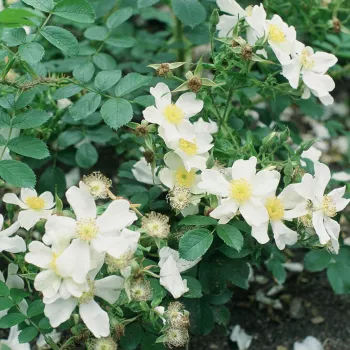
PAULII – white wild rose – Paul
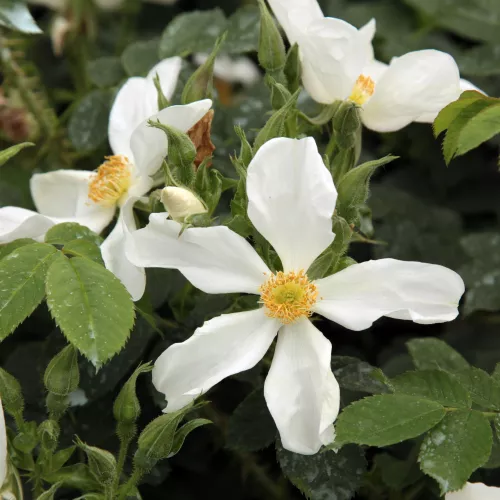
If You dream of a natural looking, arching rose that quietly fills a corner of the garden, PAULII gives You broad, spreading cover with minimal fuss. Its once-a-year display of simple snow-white blooms has a quietly elegant charm, then the petals drop cleanly, keeping maintenance light and straightforward. Tough, hardy wood on its own roots helps it settle in for the long term, coping well even where soil stays heavy after rain and drainage needs a little extra care in Irish gardens. The mid-green, matte foliage stays healthy, with excellent resistance to common rose diseases, so You can enjoy its gently spicy fragrance without worrying about sprays. PAULII is happiest with space to spread, making an ideal choice for natural hedging, relaxed boundaries and wilder corners that still feel cared for. Give it a season to root, the next to build its framework, and by the third year You will see its full character in the garden.
Use cases
| Target area | Reason |
|---|
| Low-maintenance groundcover for larger areas |
Its wide, spreading habit and dense, thorny branches naturally close gaps, suppressing weeds so You have less ongoing work. Best for gardeners who prefer robust coverage over detailed pruning, including beginners |
| Informal hedge or boundary in family gardens |
Regular height with a broad spread and plenty of thorns creates a gently protective, rural-style boundary that still looks soft and green, ideal along fences or the back of borders for homeowners seeking privacy with low input, especially families |
| Feature shrub in a cottage-style front garden |
The single, snow-white flowers and bright red hips give a traditional, old-fashioned charm without fussy care, suiting Irish cottage and village fronts where You want character and reliability, particularly appealing to lovers of heritage |
| Rugged planting for exposed or urban sites |
Good heat and drought tolerance, together with hardy wood and strong disease resistance, mean it copes well in tough spots, including coastal breezes and built-up streets where other roses struggle, reassuring time-poor urban gardeners |
| Easy-care rose bed with simple seasonal tasks |
Once established, it needs only basic pruning to keep its shape, and the flowers self-clean, reducing deadheading needs so You can focus on occasional feeding and shaping rather than constant attention, ideal for busy owners |
| Specimen shrub for naturalistic, “wild” plantings |
Its botanical character and relaxed, spreading frame blend well with grasses and meadow-style perennials, giving a soft, semi-wild look that still feels intentional, suiting those creating wildlife corners and natural-style borders |
| Planting where disease pressure is usually high |
Strong resistance to powdery mildew, black spot and rust keeps foliage presentable even in humid, rain-prone Irish summers when many roses suffer, reducing the need for sprays and reassuring environmentally conscious gardeners |
| Large, permanent planting in heavy garden soil |
Its own-root strength and hardy, adaptable constitution help it settle into heavier ground where water lingers after rain, provided You give some initial drainage care, making it a long-lived anchor shrub for patient home gardeners |
Decorating ideas
- Cottage Hedge Line – let PAULII form a loose flowering hedge, underplant with Scabiosa columbaria and sweet alyssum for a soft, cloud-like edge – ideal for romantic cottage-garden fans
- Natural Slope Cover – plant in a staggered pattern on a bank and pair with cypress spurge ‘Fens Ruby’ for contrast between white flowers and bronze foliage – perfect for low-maintenance problem slopes
- White Woodland Margin – use along a light-shade boundary with ferns and shade-tolerant perennials so its white flowers brighten the edge – suited to gardens with dappled, tree-lined boundaries
- Rural Entrance Frame – place two broad specimens by a drive or lane, backed with hydrangeas for summer fullness and hips for autumn interest – great for country homes and rural-style front gardens
- Park-Style Mixed Border – combine PAULII with ornamental grasses and simple perennials to evoke a natural park planting – appealing to those who like relaxed structure without intensive upkeep
Technical cultivar profile
| Parameter | Data |
|---|
| Name and registration |
Botanical rose from the Paul collection. Trade name PAULII, also known as Rosa paulii, a wild-type hybrid rugosa species cross. Unregistered cultivar used mainly in gardens and collections. |
| Origin and breeding |
Bred by George Paul Jr., Paul & Son, Cheshunt, United Kingdom. Introduced in 1903 from crosses involving Rosa arvensis, Rosa rugosa and Rosa wichuraiana, combining vigour, toughness and traditional character. |
| Awards and recognitions |
Highly regarded in historical rose circles; American Rose Society Dowager Rose Queen between 1998 and 2001 and multiple “Genesis” awards at American district shows from 1999 to 2014. |
| Growth and structure |
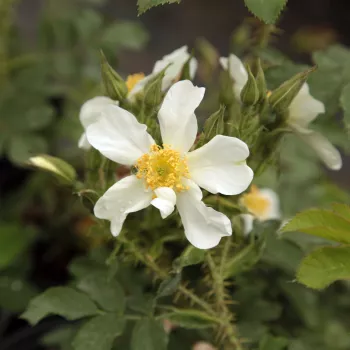
Bushy, spreading shrub reaching about 70–130 cm high with a broad 210–390 cm spread. Moderately dense, matte mid-green foliage on densely thorned shoots, forming an effective, ground-hugging thicket over time. |
| Flower morphology |
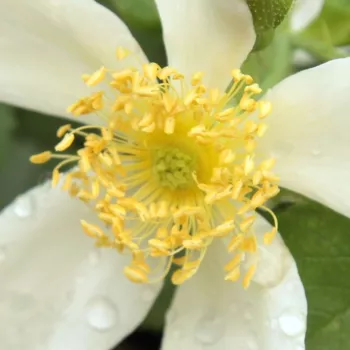
Single, flat flowers with 5–12 petals, small in size (around 1–3 cm), borne in clusters. Once-flowering, giving a concentrated late-spring to early-summer display, with petals that drop cleanly as blooms finish. |
| Colour and phenology |
Greenish ivory buds open ivory-white, quickly becoming pure snow-white. Towards the end of flowering petals turn translucent with a slight beige tint at the edges, giving a soft, natural fading effect. |
| Fragrance and aroma |
Flowers are mildly and pleasantly spicy, with a restrained scent best appreciated at close range. Fragrance adds a subtle traditional note without being overpowering in smaller front gardens or near paths. |
| Rose hip characteristics |
Produces numerous small, spherical hips around 18–26 mm across. Hips ripen to a bright red shade and add autumn and early-winter interest, standing out clearly against the shrub’s mid-green foliage. |
| Resistance and hardiness |
Noted for strong resistance to powdery mildew, black spot and rust. Winter hardy to about −29 to −26 °C (RHS H7, USDA 5a), and endures heat and moderate drought well once established in the garden. |
| Horticultural recommendations |
Suited to groundcover, informal hedging, parks and urban green spaces. Plant with wide spacing to allow natural spread. Tolerates partial shade and heavier soils; prune lightly to manage size rather than for flowers. |
PAULII offers wide, low-maintenance groundcover, strong disease resistance and long-lived own-root reliability; if You have space for its natural spread, it can be a dependable, characterful choice for your garden.