SUTTER'S GOLD – yellow climbing rose – Weeks
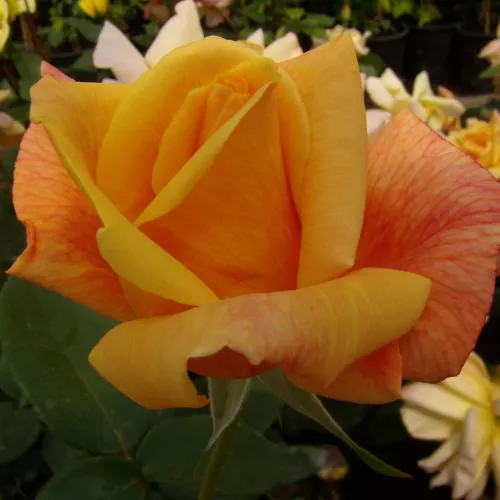
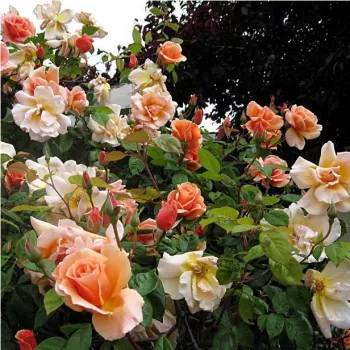
If You dream of a romantic climber that is genuinely easy to live with in Irish gardens, SUTTER'S GOLD is a classic choice. Its strong fragrant blooms and reliable repeat flowering bring colour to walls and fences from early summer well into autumn, even in our changeable, humid weather. The rich golden yellow flowers glow with warm orange tones, ideal beside cottage paths or around a front door. As an own-root rose it settles in gradually, building a long-lived, well-balanced structure that recovers well after pruning or storms. In year one it focuses on roots, in year two on more leafy shoots, and by year three it shows its full ornamental value. Its low maintenance and strong disease resistance make it reassuringly straightforward for busy or beginner gardeners.
Use cases
| Target area |
Reason |
| Front-house wall or sunny facade |
Ideal where You want a welcoming focal point without complex maintenance. The moderate height and bushy climbing habit make it easy to train along trellis or wires, giving a tidy, controlled look that still feels generous and cheerful for the busy homeowner |
| Perfumed seating area or terrace |
Strong, sweet-spicy fragrance and large double blooms make this rose perfect beside a bench, patio or evening seating spot, where the scent can be enjoyed up close and some stems can be cut for vases indoors, suiting the fragrance-lover |
| Small cottage-style arch or pergola |
Its bushy, upright climber habit and medium height suit modest arches in smaller Irish gardens, creating a romantic cottage effect without overwhelming the structure, appealing to the cottage-garden fan |
| Low-maintenance family side garden |
Resistant to common rose diseases and generally requiring little intervention, it works well where You have limited time yet still want healthy foliage and regular flowering, an advantage appreciated by the time-poor gardener |
| Coastal or exposed suburban garden |
Own-root plants form a stable, resilient framework that copes better with wind and pruning over many years, useful in sites where Atlantic breezes and damp air can test weaker roses, reassuring for the long-term planner |
| Cut-flower corner in a mixed border |
Exhibition-quality, hybrid-tea style blooms on strong stems provide elegant cut flowers, while the golden colour blends well with perennials, making it a versatile choice for the home flower-arranger |
| Partially shaded town garden fence |
Tolerates partial shade, so it copes with light levels typical of narrow side passages or overlooked urban plots, still producing good flushes of colour for the urban gardener |
| Large container by a doorway (40–50 litre minimum) |
Suited to spacious containers when given a 40–50 litre pot, quality compost and regular watering; this lets You enjoy a vertical accent of golden flowers where ground planting is limited, ideal for the balcony or patio owner |
Decorating ideas
- Golden Cottage Entrance – Train SUTTER'S GOLD over a small timber arch with lavender and creeping thyme at the base for a soft, country entrance – perfect for cottage-garden enthusiasts
- Warm Welcome Wall – Cover a sunny house wall with this climber, underplanting with sea thrift and sweet alyssum to echo its golden tones – ideal for front-garden improvers
- Perfumed Patio Nook – Grow it on a trellis beside a seating area in a large pot (40–50 litres) with pots of rosemary and herbs nearby – suited to fragrance-lovers with small spaces
- Family-Friendly Fence – Space plants along a boundary fence, combining with hardy hydrangeas in front for layered flowers and low upkeep – great for busy family gardens
- Cut-Flower Corner – Dedicate a border section to SUTTER'S GOLD with simple edging plants, giving easy access to long-stemmed, scented blooms – ideal for home bouquet makers
Technical cultivar profile
| Parameter |
Data |
| Name and registration |
Sutter’s Gold, Cl. is a climbing sport of the hybrid tea ‘Sutter’s Gold’, marketed as SUTTER'S GOLD – yellow climbing rose – Weeks; ARS approved exhibition name: Sutter’s Gold, Cl. |
| Origin and breeding |
Mutant sport of ‘Sutter’s Gold’ discovered by O. L. “Ollie” Weeks, introduced by Armstrong Nurseries, California, USA around 1950; unregistered but widely grown as a reliable climber. |
| Awards and recognitions |
The original hybrid tea ‘Sutter’s Gold’ received multiple international gold medals and the James Alexander Gamble Fragrance Medal, underlining the cultivar family’s proven ornamental and scent quality. |
| Growth and structure |
Vigorous bushy climber with upright canes, height about 100–180 cm and spread 80–140 cm under garden conditions; moderately thorny, with moderately dense, slightly glossy dark green foliage. |
| Flower morphology |
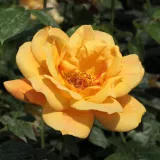
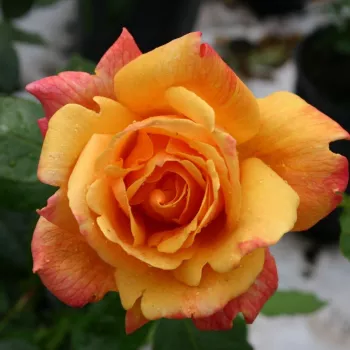
Large, double, cup-shaped blooms with 26–39 petals, mainly solitary on stems; remontant with a strong second flush, providing classic hybrid-tea form suitable for both garden display and cutting. |
| Colour and phenology |
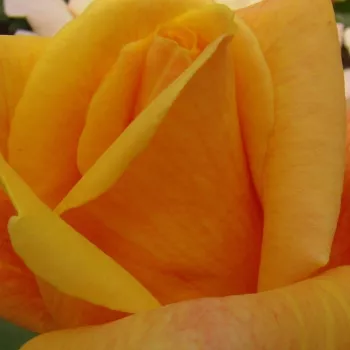
Rich golden yellow with a soft orange undertone; buds coppery-gold, opening deep golden then lightening to lemon tones and peachy centres, with some fading in strong sun over the flowering period. |
| Fragrance and aroma |
Strong, distinctive sweet-spicy rose fragrance, noticeable both on the plant and in the vase; valued historically for its scent and suitable for gardeners prioritising perfumed flowering displays. |
| Rose hip characteristics |
Rose-hip set is generally sparse due to double flowers; when present, hips are small, ovoid, orange-red, about 12–18 mm, adding occasional late-season interest without heavy seeding. |
| Resistance and hardiness |
Good resistance to powdery mildew, black spot and rust; hardy to approximately −32 to −29 °C (USDA zone 4b, RHS H7), tolerates heat with regular watering in prolonged dry spells. |
| Horticultural recommendations |
Suited to walls, fences, arches and large containers; plant with 140–230 cm spacing depending on effect, ensure well-drained soil, feed annually, deadhead by hand as self-cleaning is weak. |
SUTTER'S GOLD offers strong fragrance, reliable repeat flowering and easy-care disease resistance on a long-lived own-root framework, giving You a dependable, romantic climber to enjoy for years if You decide it suits Your garden