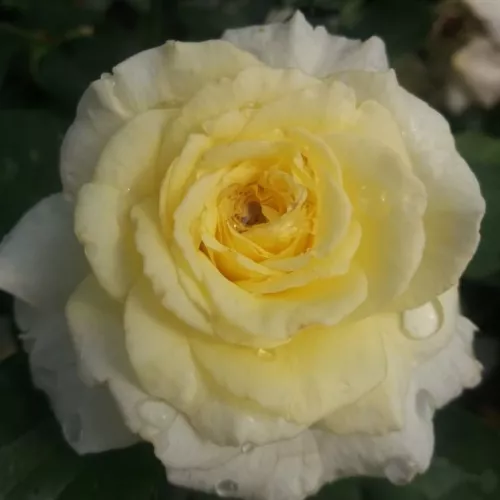
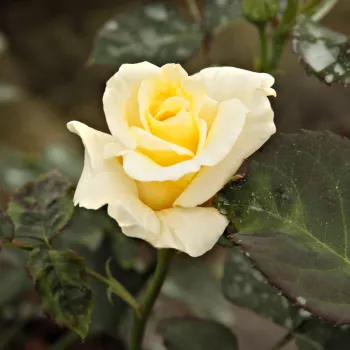
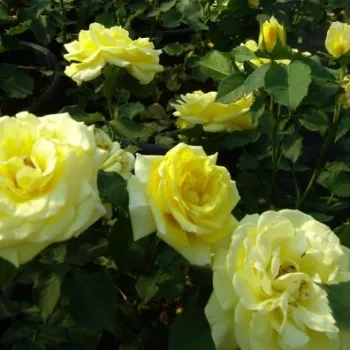
Petal colour of a medium‑intense sun‑yellow shade with a clean, homogeneous surface. - bedding floribunda rose - mild, restrained-scented rose - soft character
– Uniform mid-yellow blooms with gentle colour fade
– Reliable remontant flowering through the season
– Upright, compact habit for beds and borders
– Mildly scented flowers with soft character
– Moderately disease-resistant in typical gardens Speisialta: Rose hips with neat orange‑red décor value.
TANDINADI – yellow bedding floribunda rose - Tantau
With its softly glowing yellow pompon blooms, TANDINADI brings an effortlessly cheerful touch to Irish front gardens and family beds. This compact floribunda flowers in generous clusters over a long season, giving You a reliably colourful display without demanding expert skills. The 2‑litre own‑root plant arrives well established, so You can simply plant it, water it and enjoy how it gradually becomes a stable, long‑lived part of Your garden picture, even where soil is heavy and needs some care for better drainage. Its upright, moderately dense, glossy foliage forms a neat, bushy shape that suits smaller beds, edging and cottage‑style plantings. Over time, the own‑root structure supports good regrowth and resilience, giving You confidence that the rose can settle in for many years. Expect a natural development from strong roots first, then more shoots and branching, and by the third year a fully decorative bush with abundant flowers that still remains easy to manage in an everyday family garden.
Diana® in full bloom, showing its semi-double yellow flowers.
Diana® rose showing colour changes through several opening phases.
A TANDINADI rózsa zárt bimbója, élénk napsárga árnyalattal.
Use cases
Target area
Reason
Front garden beds along paths and drives
The compact upright habit (around 70–100 cm) forms a neat, manageable bush that does not sprawl onto paths, giving You a tidy, welcoming front garden with sunny yellow clusters from early summer to autumn, ideal for beginners
Small rose groups of 3–5 plants in family gardens
Planted at about 60 cm spacing, several TANDINADI together create a low, even ribbon of colour that is easy to look after yet has strong visual impact, perfect when You want simple massed planting rather than complicated garden designs for a busy homeowner
Mixed cottage borders with perennials and grasses
The mid-yellow, semi-double flowers blend beautifully with dwarf lavender, sedges and daisies, while the moderate height and glossy foliage weave naturally into cottage-style borders, keeping the look relaxed but still orderly for the romantic
Ornamental edging around patios and seating areas
The remontant flowering, with a generous second flush, keeps colour near Your seating spots over a long season; the semi-double flower form adds lightness and charm rather than heaviness, so the planting stays airy and inviting for the terrace-owner
Large containers on balconies, patios or at entrances
In a minimum 40–50 litre container with good compost and drainage, this upright floribunda builds a well-structured own-root bush that carries repeated clusters of bloom, giving long-lasting colour in limited space for the apartment-dweller
Coastal and exposed urban front gardens
Once established, the moderately dense, glossy foliage and sturdy framework cope well with open, breezy sites, even where Atlantic winds and rain demand thoughtful soil improvement for reliable water movement and root health for the coastal
Low informal hedging or boundary definition
Planted at around 50 cm, TANDINADI can outline driveways, lawns or play areas with a soft, friendly border, giving structure without the severity of clipped shrubs and providing a clear yet welcoming edge for the family-garden
Long-term rose features in small to medium gardens
As an own-root rose, TANDINADI gradually forms its permanent bush shape in situ, regenerating well after pruning and offering many years of reliable flowers without complex care routines, supporting a future-proof, low-fuss planting for the long-term planner
Decorating ideas
Sunlit welcome strip – Line your front path with a short row of TANDINADI to create an easy-care, sunny yellow greeting that frames the entrance without overgrowing the walkway – ideal for time-poor homeowners
Cottage trio pocket – Plant three TANDINADI in a triangle with dwarf lavender and Mexican daisies between them for a soft, romantic pocket of colour and movement – perfect for small cottage-style borders
Yellow patio focal pot – Choose a 40–50 litre terracotta container, combine TANDINADI with trailing Mexican daisy at the rim for a simple, long-flowering focal point – great for balcony and patio gardeners
Soft family hedge – Use a staggered line of TANDINADI along a lawn edge, interplanted with low sedges for texture, to mark boundaries without rigid formality – suited to family gardens with children
Warm front-bed mix – Mix TANDINADI with blue dwarf lavender and pale hydrangeas to get a gentle contrast of yellow, blue and cream in front beds – attractive for those who like harmonious, low-maintenance schemes
Technical cultivar profile
Property
Data
Name and registration
Floribunda bedding rose, registered as TANdinadi, marketed as Tandinadi Bedding rose TANdinadi and exhibition name Diana; part of the bedding rose collection with verified cultivar authenticity for consumer gardens.
Origin and breeding
Bred by Mathias Tantau Jr. for Rosen Tantau, with breeding work completed in 1977 in France; introduced commercially in 1978 and distributed by Rosen Tantau in Germany and internationally for garden use.
Growth and structure
Compact upright bush reaching about 70–100 cm in height and 55–85 cm in spread, with moderately dense, mid-green, glossy foliage and moderate prickliness, suitable for beds, edging and low structural planting.
Flower morphology
Semi-double pompon to ball-shaped blooms in medium size, typically 13–25 petals, borne in clusters on the stems; remontant with a good second flush that maintains ornamental effect through the main garden season.
Colour and phenology
Bright lemon-yellow buds open to a clear sun-yellow, then soften through mid-yellow to buttery and creamy tones; colour retention is moderate, with a uniform mid-yellow at full bloom that pales gently towards the petal edges.
Fragrance and aroma
Fragrance is mild and restrained with a soft character rather than a strong perfume, making it suitable close to seating or paths for those who prefer gentle scent rather than dominant aromatic roses.
Rose hip characteristics
Occasionally forms small, spherical orange-red hips about 10–14 mm in diameter; hips may provide modest late-season ornamental interest but are not a major feature of this floribunda cultivar.
Resistance and hardiness
Hardy in USDA zone 6b and colder climates down to about −21 to −18 °C; disease resistance is moderate to powdery mildew, black spot and rust, so basic monitoring and occasional plant protection may be advisable.
Horticultural recommendations
Best in sunny positions with improved, free-draining soil; suitable for flower beds, parks, standards and large containers; plant at 50–60 cm spacing, maintaining around 3 plants per square metre in denser massed plantings.
TANDINADI offers compact structure, long-season yellow flowering and dependable, own-root resilience that gradually builds a lasting bed or container feature, making it a reassuring choice if you want a rose that simply works.
Detailed product attributes
Product Identification Data
Product Name:
TANDINADI – yellow bedding floribunda rose - Tantau
Product Type:
pharmaROSA® ORIGINAL - 2-litre own-root potted rose
Pollinator Attraction:
Semi-double (13–25 petals) blooms with partially concealed stamens offer moderate accessibility to pollinators and are therefore moderately attractive to them.
Pollinator-Friendly Rating:
Semi-double (13–25 petals) flowers moderately attract pollinators, therefore this is a partially pollinator-friendly variety.
Our product is a rose grown with unique pharmaROSA® cultivation technology!
2 litre, own-root, potted rose.
With shoots appropriate to the season.
With roots thoroughly interwoven through the growing medium.
Quality in line with the requirements of the E.N.A. (European Nurserystock Association).
In unique packaging that prevents damage.
Can be planted during frost-free periods.
True-to-type rose plant with an individual identifier.
The pharmaROSA® own-root potted rose is a well-rooted plant that supports reliable establishment when planted and cared for properly, so it can be planted whenever the soil is not frozen.
Stock: several varieties and several stages of development in a short stock section.Shoot system: intensive growth of fresh basal shoots on a young plant.Root system: presentation of the strong root system interwoven through the growing medium with the pot removed.Balance: mature plant where the development of the root system and the shoots is in harmony.
Information about the videos
The video series is not a “seasonal showcase”, but makes the essence of pharmaROSA® own-root production tangible: how the plant is built, what the root system is like and how the shoots renew themselves. The footage was therefore taken at different times, showing plants at different stages of development, so mixed leaf coverage or differing growth stages may appear in the videos. This is not a “sample” of the batch delivered, but an illustration of how the technology works. The current condition of the rose available to order — typical of the given period and similar to what you can expect to receive in the parcel — is shown at the top of the product page.
Pages for private customers Garden roses for the family garden, with minimal care → ORIGINAL® Premium garden roses – instant impact, a truly showpiece garden → EXTRA® Pages for professionals and private customers Roses for public spaces – large areas, sustainable maintenance → NATURAL® Roses for projects – hedge and row planting, fast implementation → RAPID® For professional partners only Production – propagation material for garden roses, wholesale → NEONATAL®
Company details
PharmaRosa Ltd. Company registration number: 01-09-717479 VAT number: 13075314-2-43 Plant health registration no.: HU130721 Bank account (IBAN): HU85117631891388688400000000 BIC (SWIFT): OTPVHUHB Bank name: OTP Bank Nyrt.