VEILCHENBLAU – purple historic rambler, running-climbing rose - Kiese
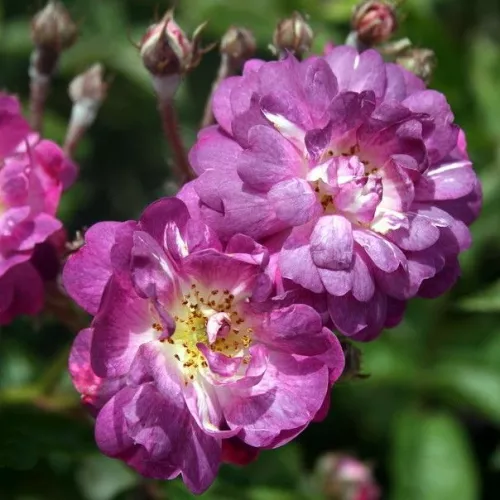
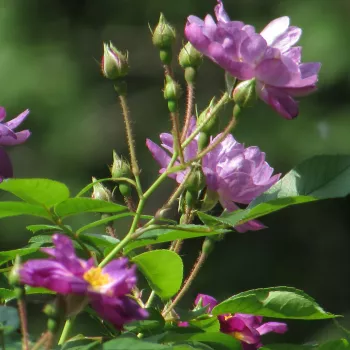
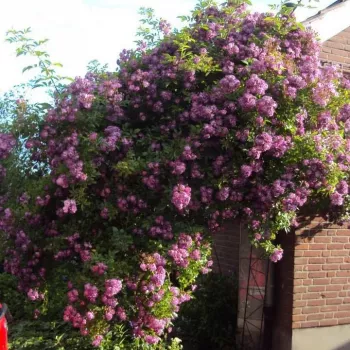
If You dream of a cottage-style rose that simply gets on with its job, Veilchenblau is a characterful historic rambler that rewards You with a dramatic wave of early-summer bloom for remarkably little fuss. Its long, trailing canes create streamlined curtains of lilac-purple flowers, perfect for softening walls, fences or an arbour in a typical Irish family garden. The semi-double, open blooms are loved by bees, giving You a quietly pollinator-friendly corner without complicated planning. Once it has settled, this own-root climber forms a stable, long-lived framework that copes well with real-world conditions, including our damp air and humidity-driven fungal pressure near the coast. Year by year it thickens into a leafy green backdrop with mid-green, glossy foliage, while its relatively prickle-light stems are easier to handle when You need to guide or tie them in. The colour display is fascinating, shifting from deeper crimson-purple buds to pastel, lilac-blue tones as the flowers mature and gently fade in the sun, giving a constantly changing tapestry of colour. Even if You are not an expert, You can rely on this medium-maintenance rambler: plant it once, water and feed it reasonably, and let it grow. It will spend its first year putting down roots, the second building stronger shoots, and by the third season You will see its full ornamental value draping Your garden in unforgettable violet-blue charm.
Use cases
| Target area |
Reason |
| Arbour or pergola in a family back garden |
Its vigorous climbing habit and long, flexible canes quickly cover an arbour or pergola with a leafy, romantic tunnel of lilac-purple flowers, creating shade and privacy in summer for family seating areas, ideal for beginners |
| Front-garden fence or boundary |
Trained along wires or a simple fence, it makes a tall, airy screen that softens boundaries without feeling heavy, and its once-a-year cloud of colour offers high impact with minimal ongoing pruning, suiting busy homeowners |
| Wall of a rural cottage or town terrace |
Well suited to large walls where its historic rambler character can be appreciated from a distance; the flowering display brightens stone or brick, while its own-root longevity builds a permanent feature for cottage-garden fans |
| Large trellis near a patio or seating corner |
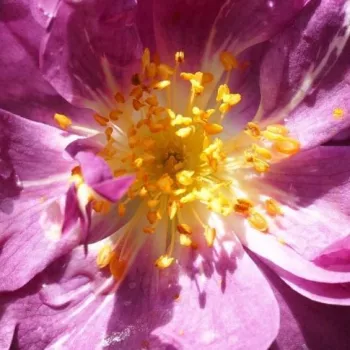
The subtly sweet, spicy scent and bee-friendly, open-centred blooms create a charming seasonal backdrop to outdoor dining; it flowers once, then rests, leaving clean green foliage that stays attractive for relaxed gardeners |
| Big, well-drained container by a sunny wall |
In a minimum 40–50 litre container with good drainage, it can be grown on a balcony or paved area, its long canes trained on a frame to give height and colour where soil is limited, an option many urban gardeners appreciate |
| Screening between neighbouring gardens |
Its dense foliage and generous spread create a soft-focus visual barrier; slightly prickly stems discourage unwanted through-traffic while remaining easier to manage than very thorny climbers, a compromise valued by families |
| Large, informal mixed border with shrubs |
Weaving it through sturdy shrubs or small trees adds a vintage layer of lilac-purple flowers above existing planting; it tolerates average or poorer soils, reducing the need for enrichment for cost-conscious gardeners |
| Coastal or exposed Irish garden structures |
Once established on a pergola or strong fence, its flexible growth copes well with wind and damp, and it performs reliably even where rain and air movement increase the pressure of fungal problems, reassuring less confident owners |
Decorating ideas
- Cottage Pergola Tunnel – Let Veilchenblau drape over a wooden pergola, underplanted with lavender and catmint for a soft lilac-blue haze – ideal for romantic cottage-style enthusiasts.
- Storybook Front Fence – Train it along a low front-garden fence with white foxgloves and hardy geraniums at the base for a welcoming, low-effort street frontage – perfect for busy homeowners.
- Patio Feature Trellis – Grow it in a 40–50 litre pot on a sturdy trellis, paired with pots of rosemary and thyme for scent and texture – great for small urban patios.
- Rural Wall Cascade – Allow its canes to spill down a stone wall, backed by hydrangeas and meadow sage to extend colour after its main flush – suited to country cottage gardeners.
- Wildlife-Friendly Screen – Use it as a loose screen with bluebeard shrub and silky dogwood, giving bees accessible flowers and birds shelter – attractive for nature-loving families.
Technical cultivar profile
| Property |
Data |
| Name and registration |
Veilchenblau historic rambler rose by Kiese, commercial type historic trailing climber; trade name Veilchenblau, American Rose Society exhibition name Veilchenblau, unregistered cultivar widely known since the early 20th century. |
| Origin and breeding |
Bred by Hermann Kiese in Germany around 1909 from Turner’s Crimson Rambler × Souvenir de Brod; distributed by Johann Christoph Schmidt as a vigorous hybrid multiflora, now classed among historical ramblers and climbers. |
| Awards and recognitions |
Holds the Royal Horticultural Society Award of Garden Merit (1993), recognising reliable performance, ornamental value and garden worthiness under a range of conditions in ordinary gardens. |
| Growth and structure |
Strong, climbing rambler with long, supple canes reaching about 400–600 cm in height and 200–400 cm spread; dense mid-green, glossy foliage and only slight prickliness, ideal for training on arbours, pergolas, fences or walls. |
| Flower morphology |
Semi-double, small flowers around 0.5–1.5 inches wide, borne in large, clustered trusses; flat, open form with 13–20 petals per bloom, allowing easy access to the central stamens for pollinating insects during the main flowering period. |
| Colour and phenology |
Buds open crimson purple, then soften to lighter purple-lilac with pinkish tips, finally fading to pastel lilac and bluish-grey tones with whitish centres; non-remontant rambler, flowering once in early summer yet producing a highly memorable display. |
| Fragrance and aroma |
Offers a mild but noticeable sweetly spicy fragrance best appreciated when planted near seating or paths; while not overpowering, the scent adds an old-fashioned charm that complements its historical character and abundant trusses. |
| Rose hip characteristics |
Occasional small hips form after flowering, round and brownish-red, about 5–9 mm in diameter; they add a subtle autumn interest and provide a light food source for birds without dominating the plant’s appearance. |
| Resistance and hardiness |
Hardy to about −32 to −29 °C (USDA zone 4b, RHS H7, Swedish zone 5); disease resistance is medium for black spot, mildew and rust, performing well in open, ventilated positions with routine care and adequate watering during summer droughts. |
| Horticultural recommendations |
Best on arbours, pergolas, fences or walls in sun to light shade; allow space using 180–330 cm spacing depending on use. In Ireland, plant in well-drained soil, provide sturdy support, tie in new canes, and prune lightly after flowering to manage size. |
Veilchenblau offers a spectacular early-summer violet-blue display, pollinator-friendly open blooms and long-lived own-root reliability for arbours, fences or cottage walls, making it a practical and characterful choice if You would like a dependable rambler.