VIOLET HOOD – violet-purple park rose – Lens
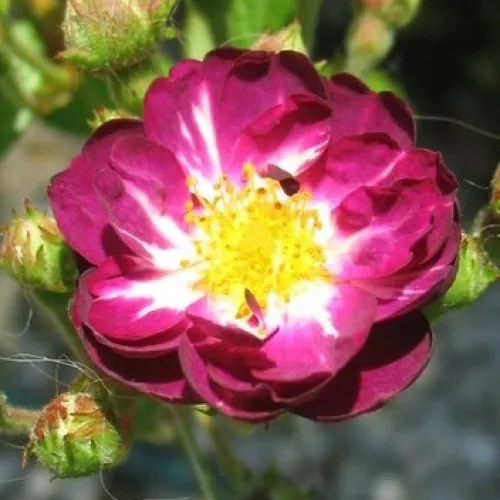
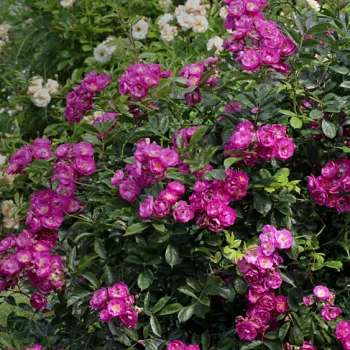
With its natural cottage-garden charm and purple clusters of semi-double blooms, Violet Hood is an easy-going shrub rose that settles in reliably even in humid Irish weather where fungal problems are common. You get an own-root plant in a handy 2-litre pot that is already well started, so it is simple to position, water and watch it grow without complicated routines – a genuine beginner ally for small family gardens and relaxed front borders. Its compact, hedge-friendly habit and dark, slightly glossy foliage give structure all season, while the flowers repeat generously from early summer into autumn, forming a steady, colourful background to daily life. Over the first year it quietly builds roots, in the second year the framework thickens, and by the third year it reaches full ornamental value for long-term reliability. In autumn, small, spherical red hips add seasonal interest for a more natural, wildlife-aware planting style that suits both town and rural gardens.
Use cases
| Target area |
Reason |
| Front garden focal shrub by the entrance path |
The compact 90–140 cm height and 50–80 cm spread make Violet Hood ideal as a welcoming feature that does not overpower a small Irish front garden, giving a defined shape and long-term structure for busy homeowners |
| Informal low hedge along a boundary or driveway |
Planted about 50 cm apart, this park rose forms a low, flowering hedge with moderately thorny stems for gentle deterrence, while remaining easy to clip and care for without advanced pruning skills for beginner gardeners |
| Mixed border with perennials in a family back garden |
Its repeat-flowering clusters of violet-purple blooms create a soft background for perennials and grasses, giving colour from early summer into autumn with only medium maintenance and straightforward seasonal care for family gardens |
| Small groups of 3 shrubs in cottage-style beds |
Set in groups using the recommended 60 cm spacing, Violet Hood builds a rounded, harmonious outline, with own-root growth ensuring the bush slowly thickens and regenerates for many seasons, supporting long-lived plantings for romantic gardeners |
| Coastal or exposed suburban front gardens |
This sturdy Hybrid Musk shrub copes well with breezier sites and changeable Atlantic conditions, making it a reliable choice where simple, resilient roses are needed in spots often affected by damp, fungus-prone air for Irish homeowners |
| Large patio pot or container planting |
In a minimum 40–50 litre container with good drainage, Violet Hood offers abundant colour near seating areas, its compact habit suiting terraces or balconies where you want a tidy, upright rose that is easy to water and feed for urban gardeners |
| Wildlife-aware corners with autumn interest |
After flowering, the shrub can develop many small, spherical red hips, lending seasonal colour and light wildlife value, making it a good fit for relaxed lawn edges and nature-friendly pockets without demanding extra work for nature lovers |
| Low-maintenance family play areas and lawn edges |
Medium disease resistance and steady repeat flowering mean you can enjoy colour beside play lawns or seating areas without constant spraying, provided you give basic watering and occasional feeding support for busy families |
Decorating ideas
- Cottage Hedge – Plant a loose edging hedge of Violet Hood interwoven with lavender and Calamintha ‘Elfin Purple’ to frame a path with soft purple tones – ideal for fans of rural cottage-garden charm
- Front Door Welcome – Use a single shrub near the entrance with underplanting of white violas and silver-leaved herbs to highlight its dark blooms – perfect for homeowners wanting an easy, elegant welcome
- Grassy Drift – Combine small groups of Violet Hood with Pennisetum alopecuroides and other airy grasses for a flowing, low-maintenance border – suited to busy gardeners who like movement and texture
- Container Feature – In a 40–50 litre pot, pair Violet Hood with trailing thyme and seasonal bedding for a long-season display on patio or balcony – great for urban residents with limited planting space
- Autumn Accent – Let Violet Hood mingle with Phormium ‘Tom Thumb’ and late-flowering perennials so its red hips echo warm foliage tones – attractive for those who enjoy subtle, naturalistic autumn colour
Technical cultivar profile
| Parameter |
Data |
| Name and registration |
Trade name Violet Hood, Hybrid Musk shrub in the Park – shrub rose group; ARS exhibition name Violet Hood; collection use as a park and landscape shrub for gardens and public plantings. |
| Origin and breeding |
Bred by Louis Lens in Belgium from ‘Robin Hood’ × ‘Baby Faurax’; breeding completed in 1973, introduced and registered in 1975 by Lens Roses and Pépinières Louis Lens for European garden use. |
| Awards and recognitions |
Kortrijk International Rose Exhibition Silver Medal in 1978, reflecting its ornamental and garden performance qualities as a landscape shrub rose suitable for broader planting schemes and collectors. |
| Growth and structure |
Compact, moderately thorny shrub 90–140 cm tall and 50–80 cm wide, with moderately dense, slightly glossy dark green foliage that includes a brownish tinge, forming a rounded, bushy framework over time. |
| Flower morphology |
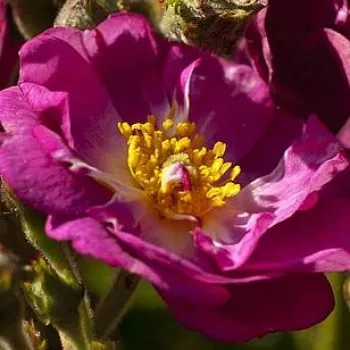
Semi-double, flat blooms with 13–25 petals in small clusters; flowers are small (about 0.5–1.5 inches), repeat freely through the season, with petals dropping to reveal developing hips later in the year. |
| Colour and phenology |
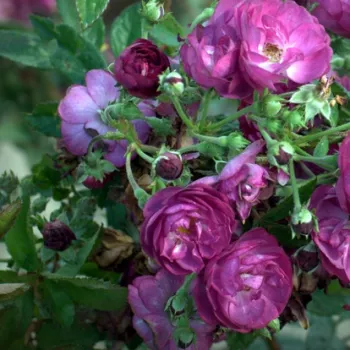
Closed buds are deep, almost black purple; newly opened blooms show intense velvety lavender purple, maturing to matte mauve with lightened edges and eventually a brownish-mauve tone, with good overall colour retention. |
| Fragrance and aroma |
Classified as a scentless rose with no noticeable fragrance; grown primarily for its strong colour effect, repeat flowering and structural presence rather than for perfume, which suits those less focused on scent. |
| Rose hip characteristics |
In autumn it may carry many small, spherical red hips 6–10 mm across, providing extra seasonal interest and a naturalistic look useful in wildlife-friendly or low-maintenance ornamental plantings. |
| Resistance and hardiness |
Hardy to around −21 to −18 °C (RHS H7, USDA 6b, Swedish zone 3); medium resistance to powdery mildew and black spot, good resistance to rust, needing only occasional standard rose care in typical gardens. |
| Horticultural recommendations |
Best in an open sunny position; space 60 cm in mass plantings, 50 cm for hedges, around 100 cm as a specimen; plant in well-drained soil, water regularly and feed annually to support repeat flowering. |
Violet Hood offers compact, repeat flowering colour, compact hedge-friendly structure and attractive autumn hips, while its own-root habit supports long-lived, steadily improving shrubs; a reassuring choice if you prefer a rose that simply works.